The Carrier Oil Guide: Jojoba, Coconut, Almond — and How to Actually Choose One
The unglamorous base every diluted blend sits in — what each carrier really is, which ones go rancid fast, why comedogenic ratings are folklore, and how to pick by texture and use.
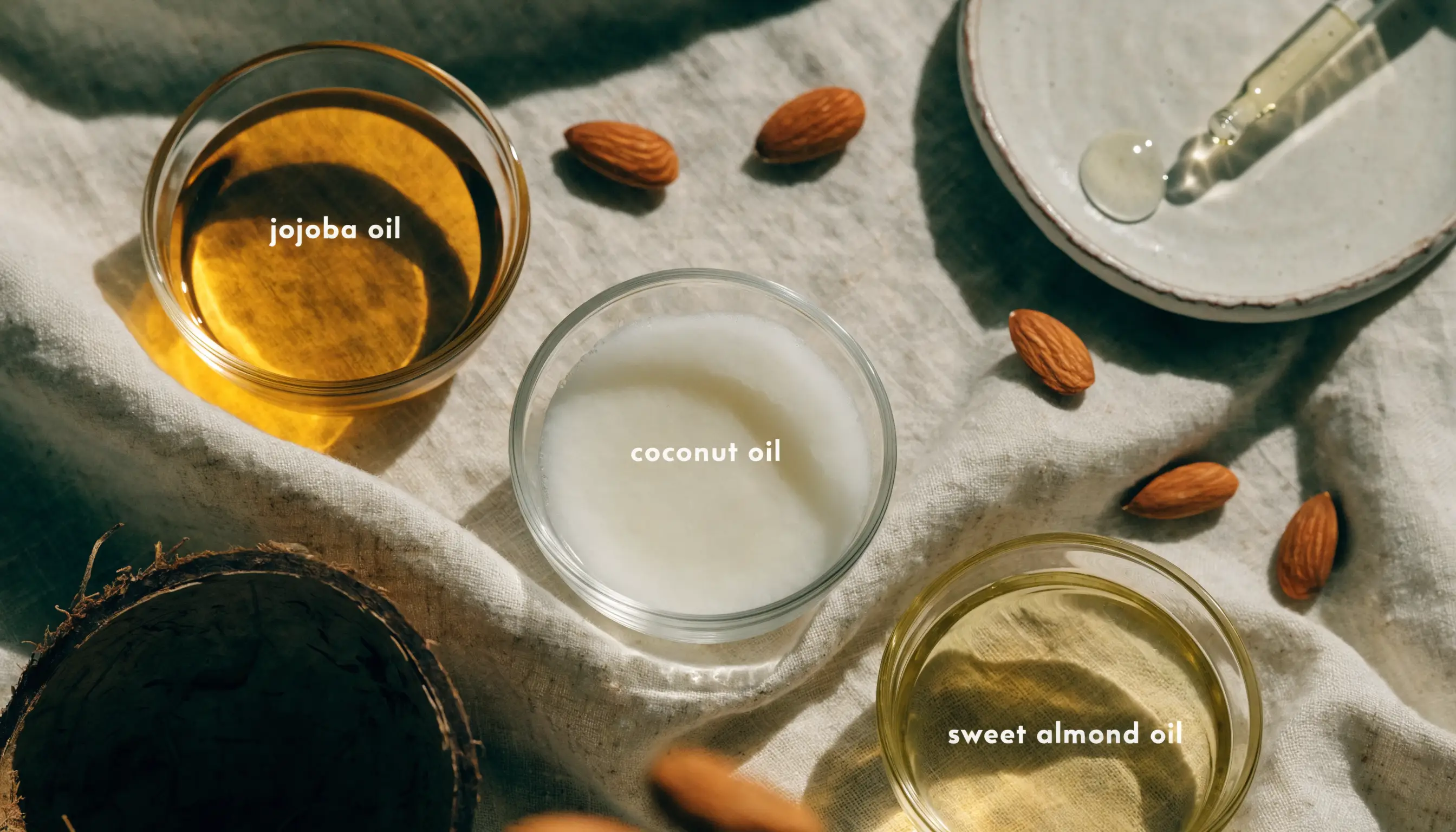
Essential oils get all the romance. The carrier oil — the plain, fatty vegetable oil you actually rub into your skin — gets none, and that's a mistake. A blend is mostly carrier. Two or three percent of it is the aromatic oil everyone talks about; the other ninety-seven-odd percent is the base, and that base decides how the blend feels, how long it lasts, and whether it suits your skin at all.
This guide is about that unglamorous majority. What a carrier actually is, why you can't skip it, how the main ones differ, which go off fastest, and how to choose without leaning on the received wisdom that clutters this corner of the internet.
What a carrier oil is — and why dilution needs one
An essential oil is a concentrated aromatic plant extract, usually steam-distilled (or cold-pressed, for citrus peels): a single drop represents a startling amount of plant material. Applied neat, that concentration is exactly what makes it risky — irritation and, over time, sensitisation. A carrier oil is a fatty (fixed) vegetable oil that dilutes the concentrate down to a skin-safe strength before it ever touches you. The standard maxima are gentle for a reason: around 1% on the face, 2% on the body, up to 3% short-term — figures for healthy adults. A dilution calculator will do that arithmetic for you, but the principle is worth internalising.
Those maxima are a starting point, not a universal permit. For babies and young children, during pregnancy or breastfeeding, and for elderly or medically fragile skin, the safe figures are lower — and some essential oils are off the table entirely — so consult a qualified aromatherapist or health professional rather than a chart.
One thing a carrier is not: a way to make an essential oil drinkable, and not a substitute for a proper dispersant in the bath. Oils don't dissolve in water — drop them in bathwater and they float as neat little slicks, which is the opposite of diluted. Skin contact needs a fatty carrier, full stop.
The main carriers, honestly
Jojoba (Simmondsia chinensis) — the one that isn't an oil. Here's the fact almost every label gets wrong: jojoba is not a true oil at all. It's a liquid wax ester — almost entirely wax esters, where nearly every other carrier is a triglyceride fat. Mature jojoba seeds are 40–60% liquid wax by weight, built from long-chain fatty acids and alcohols that structurally resemble some components of human sebum. That's why it feels so light and skin-compatible — not because it "balances" anything, but because the molecules are simply a good structural match. Its other advantage is stability: in a 2026 comparative study (which tested rosehip, sunflower, olive and jojoba) jojoba had the longest induction period of the oils tested, giving it a practical shelf life measured in years — long, though not forever. Long-lasting, near-odourless, light.
Fractionated coconut vs. virgin coconut (Cocos nucifera) — two very different things. This trips up more people than any other carrier. Fractionated coconut oil (FCO) has had its longer-chain fats removed — "fractionation" just means separating fats by melting point — leaving mostly medium-chain triglycerides, the caprylic (C8) and capric (C10) acids, at roughly 60/40. The result stays liquid, is colourless and virtually odourless, and won't solidify at room temperature the way virgin coconut oil does. It's chemically close to dietary "MCT oil," though the two are specced and sold for different uses — and cosmetic-grade FCO is not a food: don't swallow it or cook with it. Virgin coconut oil is the opposite animal: solid below about 24°C (76°F), thanks to its 45–50% lauric acid, and heavier and more occlusive on skin. Great as a body-butter base for those who like it; awkward and clumpy as a roller carrier.
Sweet almond (Prunus dulcis) — mid-weight, with an asterisk. A slightly heavier oil with lovely "slip," which is why it's a traditional massage base. The asterisk is real: almond is a tree nut, and cold-pressed unrefined versions can retain residual nut proteins capable of triggering allergic reactions. More on that below.
Grapeseed (Vitis vinifera) — feather-light, short-lived. Wonderfully non-greasy and fast-absorbing because it's 58–78% linoleic acid. That same high polyunsaturated content is its weakness: it oxidises fast. Buy it small, use it quickly, don't stockpile it.
Argan (Argania spinosa) — richer, and steadier than it looks. About 80% unsaturated fat, mostly oleic and linoleic acid, and notably rich in tocopherols (vitamin E) — a total of roughly 600–700 mg/kg, richer than olive oil. Those natural antioxidants give it decent stability for a mostly-unsaturated oil and a heavier, more cushioned facial feel than grapeseed.
Rosehip (Rosa canina) — the diva. Very high in polyunsaturates — about 54% linoleic and 19% alpha-linolenic acid — which is precisely why it was the least oxidatively stable of the four oils in that 2026 study. Unrefined rosehip typically keeps only 6–12 months and belongs in the fridge after opening.
Olive (Olea europaea) — a cautionary note. Olive oil is oleic-heavy (~70–80%), and it's often recommended for dry skin and baby massage. The evidence pushes back: in a controlled study, twice-daily olive oil for four weeks measurably reduced skin-barrier integrity and caused mild redness, while sunflower oil preserved the barrier. The authors specifically discouraged olive oil for dry skin and infant massage. That trial was on adult forearms, though — later studies on babies themselves have found no oil clearly beneficial for the infant skin barrier, so for infant massage ask a midwife, health visitor, or paediatric professional rather than picking an oil off a blog. (The dilution guidance in this piece is for adults.)
Oxidation and shelf life
Rancidity isn't mysterious. Polyunsaturated fatty acids carry multiple carbon–carbon double bonds, and each one is a site where oxygen can attack — so the more polyunsaturated an oil, the faster it goes off. That single mechanism ranks the whole shelf: wax esters (jojoba) and medium-chain triglycerides (FCO) are the most stable; oleic-rich oils (argan, olive) sit in the middle; linoleic- and linolenic-rich oils (grapeseed, rosehip) are the first to turn.
You can smell when it's happened — rancid oil takes on an off, "crayon-like" or bitter note, and may thicken or change colour. Discard it; oxidised oils can irritate skin. Store carriers cool, dark, and tightly capped, refrigerate the high-PUFA ones, and buy quantities you'll actually finish. And no, a splash of vitamin E won't rescue an already-perishable oil — it offers only modest protection; storage and batch size matter far more.
💡 Buy small, not bulk — The lighter and faster-absorbing the oil, the more polyunsaturated it tends to be, and the faster it turns. Match bottle size to how quickly you'll actually use it.
About those "comedogenic ratings"
You'll see carriers ranked 0–5 for how likely they are to clog pores — coconut oil famously scores a 4. Treat that scale as folklore. It originates from 1972 "acne cosmetica" work and a rabbit-ear assay, later popularised by a 1989 ingredient ranking. The problem is the method: rabbit ear skin is far more sensitive and anatomically different from ours, ingredients were tested at unrealistic 100% concentrations, and in one comparison only 8 of 27 ingredients that scored high on the scale actually produced comedones in humans.
So coconut's "4" is a number from a flawed test, not a verdict on your face. And the tempting shortcut — reading an oil's pore-clogging potential off its fatty-acid profile — doesn't hold up either: there's no straightforward relationship between the two, and response varies person to person. Don't declare coconut a universal pore-clogger; don't declare it universally safe either. Individual response is what matters, and a patch test is the way to find yours.
💡 The number is a starting guess, not a diagnosis — Comedogenicity depends on dose and formula: a light oil at 2% in a blend behaves nothing like the neat ingredient smeared on a rabbit's ear. Your own patch test is the only rating that counts.
Choosing by use case
| Carrier | Texture / absorption | Shelf life | Scent | Best for |
|---|---|---|---|---|
| Jojoba | Light, dry, non-greasy | Years | Near-odourless | Face, rollers, leave-on blends |
| Fractionated coconut | Thin, dry, slippery | Very long | None | Rollers, unscented massage |
| Sweet almond | Mid-weight, good slip | Moderate | Faintly nutty | Massage (⚠ tree nut) |
| Grapeseed | Very light, fast-absorbing | Short — buy small | Faint | Lightweight face/body, oily skin |
| Argan | Rich, cushioned | Medium–long | Nutty | Facial oils |
| Rosehip | Dry, fast-absorbing | Short — refrigerate | Earthy | Facial oils (used up quickly) |
| Virgin coconut | Solid, heavy, occlusive | Long | Coconut | Body butter base only |
For a roller, you want thin, odourless, and shelf-stable: fractionated coconut or jojoba. For massage, slip and a slower absorption help — sweet almond (if no nut allergy) or FCO for an unscented base. For the face, jojoba is a strong light default; argan if you like a richer feel; rosehip if you'll keep it cold and use it fast.
Patch testing, and when to skip the nut oils
Before a new blend, apply a small amount diluted in carrier — a common start is 1 drop of essential oil per teaspoon (5 ml), about 1% — to a clean, dry inner forearm, cover it, keep it dry, and check at 48 hours for redness, itching, or irritation. It tells you more than any chart ever will.
On nut oils: don't overstate the risk, and don't wave it away. The single most useful fact is that most of a nut oil's allergenic potential lives in its proteins, and crude, unrefined oils carry far more residual protein than refined ones — on the order of a hundred times more; in a controlled challenge of 60 peanut-allergic adults, six reacted to crude peanut oil and none to the refined form. But refining reduces protein rather than reliably eliminating it, residual levels vary by batch, and those data are for peanut — a legume — not for almond, a tree nut. So the headline advice is simple: if you or anyone in your household has a known tree-nut or peanut allergy, avoid nut-derived carriers like almond altogether — refined or not — unless a clinician tells you otherwise, and reach for a non-nut base such as jojoba, fractionated coconut, or grapeseed. The sharpest caution is unrefined, cold-pressed nut oil on broken or inflamed skin, where a compromised barrier is a plausible route of sensitisation — a particular concern for infants.
The short version
- A carrier is the fatty base that dilutes concentrated essential oils to skin-safe strength — for healthy adults, roughly 1% on the face, 2% on the body, up to 3% short-term (lower, or only with professional guidance, for children, pregnancy, and fragile skin). Oils don't disperse in water.
- Jojoba is a wax ester, not an oil — light, sebum-like, and stable for years. Fractionated coconut stays liquid, odourless, and long-lasting; virgin coconut goes solid and heavy — don't confuse them.
- The more polyunsaturated the oil, the faster it goes rancid: grapeseed and rosehip are short-lived (refrigerate rosehip); jojoba and FCO last longest. Vitamin E won't save a perishable oil.
- Comedogenic 0–5 ratings are folklore from a 1970s rabbit-ear test — only 8 of 27 high-scoring ingredients caused comedones in humans. Patch-test instead.
- If you or your household has a nut allergy, avoid nut oils like almond altogether; take extra care with unrefined oils on broken skin. And olive oil isn't the gentle baby-massage oil it's reputed to be.
Safety note: This article is for general interest and is not medical or veterinary advice. Carrier oils are for diluting essential oils for skin use — not for making any oil safe to swallow, and not a substitute for professional guidance. Dilute before skin contact, patch-test every new blend, and store oils cool and dark. Take extra care with nut oils, with broken skin, around anyone with allergies, during pregnancy or breastfeeding, and around babies, young children, and pets. Further reading: Tisserand Institute safety guidelines.
For education only — not medical or veterinary advice. Essential oils are not intended to diagnose, treat, cure, or prevent any condition. Always patch-test and consult a qualified professional before use during pregnancy, on children, with pets, or with a health condition.