Essential Oils for Everyday Wellness: Sleep, Stress & Focus
The essential oils commonly reached for around sleep, stress, skin comfort and focus — how they're used in everyday routines, with safe dilution in mind.
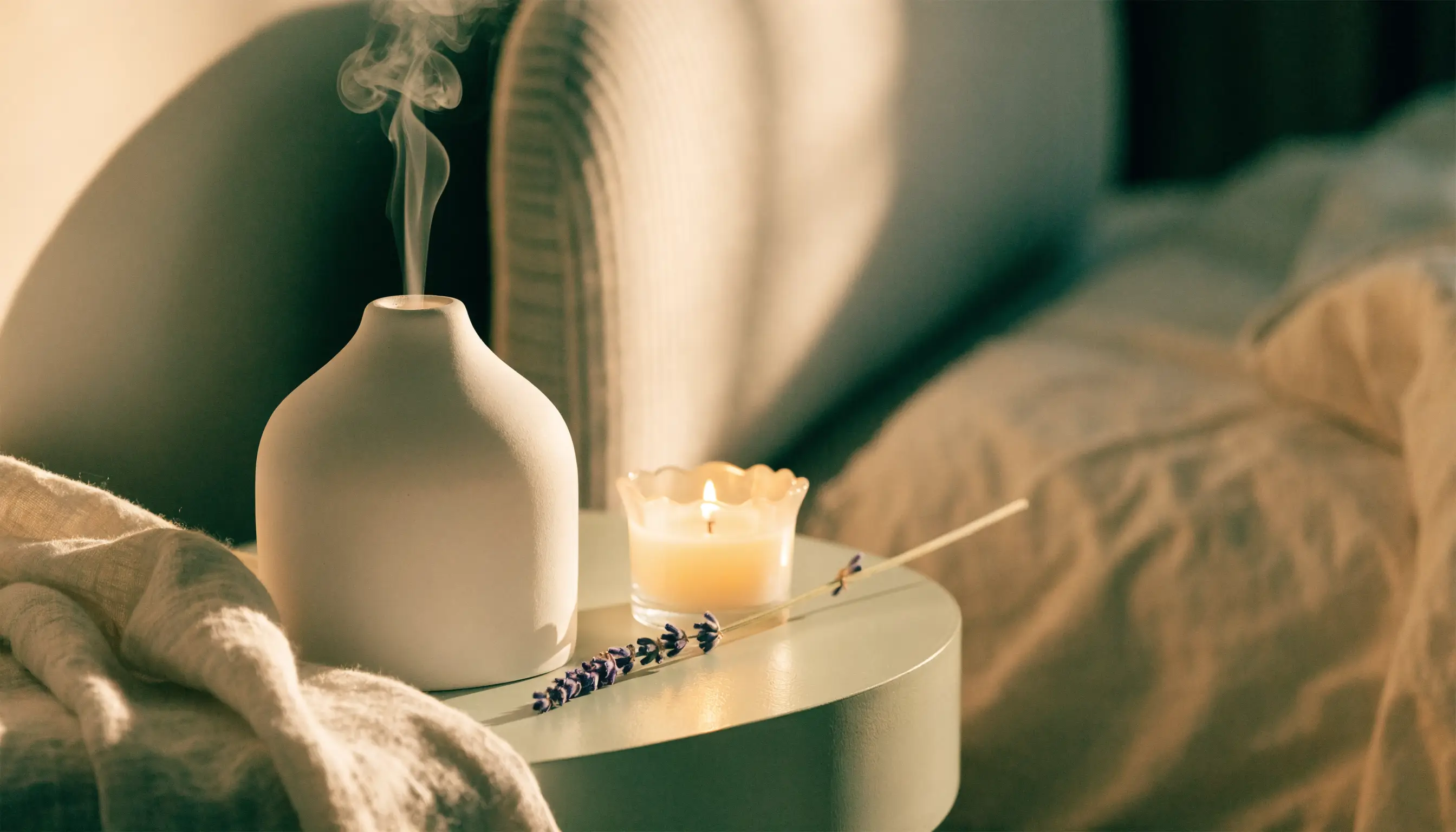
Essential oils are not medicine, and they are not a cure for anything — but many people find them a pleasant part of a wind-down routine or a workspace. Some oils have been studied for effects on relaxation or mood, though the research is often small, short, and mixed. This guide covers five popular use categories in aromatherapy with honest framing of what studies do and do not show, plus the safety basics that matter more than any recipe.
This is not medical or veterinary advice. If you are pregnant or breastfeeding, have a health condition, take medication, or are choosing anything for a child, an older adult, or a home with pets, please consult a qualified professional first.
Sleep and Relaxation
Sleep and stress are two of the most common reasons people reach for essential oils. Lavender is the most-studied oil in this category. A systematic review of lavender for anxiety found some evidence that it may help with self-reported anxiety, but the studies were heterogeneous, used different routes of administration (oral capsules, inhalation, massage), and varied in quality — so the findings should be read as promising rather than proven. Many people simply find the scent pleasant and calming as part of a bedtime routine.
Cedarwood contains cedrol, a compound that some early studies have looked at for mild calming effects; the evidence is limited and preliminary. Vetiver's deep, earthy aroma is favoured by people who find lighter scents too faint. Bergamot is unusual among citrus oils in that many people find it relaxing rather than stimulating. (Note: expressed bergamot is phototoxic on skin — keep it to the diffuser, or use a bergaptene-free "FCF" grade for any leave-on product, and see the safety note below.)
A simple, consistent approach tends to work best: diffuse a scent you like in the bedroom for a while before bed, most nights. Over time, many people form an association between a familiar scent and winding down. This is a matter of habit and preference, not a treatment — if you have ongoing sleep problems, speak to a healthcare professional.
A sleep diffuser blend: 3 drops lavender, 2 drops cedarwood, 1 drop bergamot. Run the diffuser intermittently (for example, 30–60 minutes) in a ventilated room. Keep diffusers away from pets, birds, and young children, and stop if anyone experiences irritation.
Skin Health and Beauty
Tea tree oil is among the more-studied essential oils for blemish-prone skin, but the useful evidence is for formulated products, not homemade oil. Studies have looked at low-concentration, formulated tea tree gels — not neat oil — alongside conventional options; a diluted, well-formulated product is very different from dabbing neat oil on your face, which can irritate and sensitise skin. If you are dealing with persistent acne, a dermatologist can help you choose something appropriate — that is genuinely the better route than a DIY blend.
Rose oil is popular in facial products and many people enjoy its scent and feel on the skin. Facial skin is thinner and more reactive than body skin, so if you do make a facial oil, keep the essential-oil concentration low (around 1% or less) and always patch test on the inner forearm first. A patch test can reveal an immediate reaction, but it does not guarantee you won't become sensitised later, so introduce new blends slowly and stop at the first sign of redness or itching.
Rosehip seed oil is a well-liked carrier oil for facial serums — it is light and pleasant. It is a natural, variable plant oil, however, and is not equivalent to a prescription retinoid such as tretinoin; if you want retinoid results, that is a conversation for a doctor or dermatologist.
Soothing and Comfort
Peppermint is popular for its cooling sensation, and there is one commonly cited study behind the "peppermint for headache" idea. In a small 1996 study (Göbel et al.), a 10% peppermint oil in ethanol solution spread across the forehead and temples was reported to be comparable to about 1,000 mg of paracetamol for tension-type headache. That was a specific alcoholic solution used in a clinical setting — not the same as a homemade roller, and peppermint should be kept well away from the eyes and face. Keep peppermint away from young children entirely, as it can cause breathing problems near their faces. A new, severe, or unusual headache should be checked by a healthcare professional, not self-treated.
For a general muscle wind-down, some people enjoy a light massage oil. A body massage roller/oil blend (about 2%): in 30 ml (1 oz) of carrier oil, use roughly 8 drops eucalyptus and 4 drops lavender, applied to the shoulders, back, or legs — not the face, not broken skin, and not on children. Menthol and 1,8-cineole (in peppermint and eucalyptus) produce a cooling sensation many people find pleasant; this is a feeling, not a treatment.
Focus, Productivity and Mood
The link between scent and how alert or focused we feel is an active area of study, but the results are modest and preliminary. In a small study of rosemary aroma and cognition, participants in a rosemary-scented room performed differently on some cognitive tasks, and 1,8-cineole was detectable in their blood. It's an interesting finding from a small sample — enough to make rosemary a pleasant desk scent, not enough to promise better memory.
Peppermint and lemon are popular "bright, awake" scents. A simple focus diffuser blend many people like: 3 drops rosemary, 2 drops lemon, 1 drop peppermint. Sweet orange, grapefruit, and bergamot are common uplifting citrus choices. Run the diffuser intermittently in a ventilated space, and keep it away from pets, birds, and young children — several of these oils (citrus, peppermint, eucalyptus, tea tree) can be harmful to cats and birds in particular.
Building a scent into your workday can be a nice ritual: one blend in the morning, another in the afternoon, a calmer one as you finish. Treat it as ambience and habit rather than a performance enhancer.
Breathing Comfort and Cosy Scents
In colder months, many people enjoy diffusing eucalyptus, lemon, or pine simply because the scent feels fresh and seasonal. Enjoy these as pleasant aromas rather than as remedies — essential oils do not disinfect the air or treat coughs and colds, and open-bowl steam inhalation is best avoided because of the risk of scalds (advice echoed by the NHS and the British Burn Association).
If you like a warming chest rub, it should be adults only: in 30 ml of carrier oil, use up to ~8 drops of Eucalyptus globulus or Eucalyptus radiata essential oil, applied to the chest — never the face, never on broken skin, and never on infants or young children, for whom eucalyptus and peppermint near the face can cause serious breathing problems. If in doubt, a commercially formulated rub is the safer choice, and any persistent breathing symptoms deserve a doctor's attention.
Interesting Facts
Australia has a long history of tea tree cultivation, and tea tree oil became one of the country's better-known botanical exports in the twentieth century. As a plant oil it has been valued and studied — but "studied" is not "proven to treat infection," and it should never be applied neat to skin.
Rosehip seed oil has a long history in skincare and remains a favourite lightweight carrier oil. It's worth enjoying for what it is — a pleasant plant oil — rather than for claims that it matches prescription treatments.
A note on the wider story often told about essential oils: aromatic and botanical practices have a long history across many cultures, and figures such as Avicenna refined distillation methods centuries ago. Terms like "therapeutic grade," by contrast, have no government or FDA definition — they are marketing language, so treat them with healthy scepticism.
Safety note: This article is for general information only and is not medical or veterinary advice. Essential oils are concentrated — always dilute for skin, keep them away from eyes, and never take them internally without professional guidance. Citrus and several other oils can be phototoxic (avoid sun/UV on treated skin), and many oils are not recommended in pregnancy or for infants and young children. Keep diffusion and any oils well away from pets and birds. Consult a qualified healthcare or veterinary professional before use if you are pregnant, breastfeeding, unwell, on medication, or caring for a child, older adult, or animal.
References
- Tisserand Institute — Safety guidelines
- Tisserand Institute — Phototoxicity, essential oils, sun and safety
- Tisserand Institute — Cats and essential oil safety
- ASPCA — The essentials on essential oils around pets
- British Burn Association — Patient advice
- NHS
- Lavender for anxiety — systematic review (PubMed 32088511)
- Peppermint oil for tension headache, Göbel et al. 1996 (PubMed 8805113)
- Rosemary aroma and cognitive performance (PubMed 23983963)
For education only — not medical or veterinary advice. Essential oils are not intended to diagnose, treat, cure, or prevent any condition. Always patch-test and consult a qualified professional before use during pregnancy, on children, with pets, or with a health condition.