Lavender Oil, Honestly: What the Blue Hills of Provence Can (and Can't) Do
A grower's-eye guide to the world's most loved essential oil — its history, how it's really made, what the science says, and the uses most people never hear about.
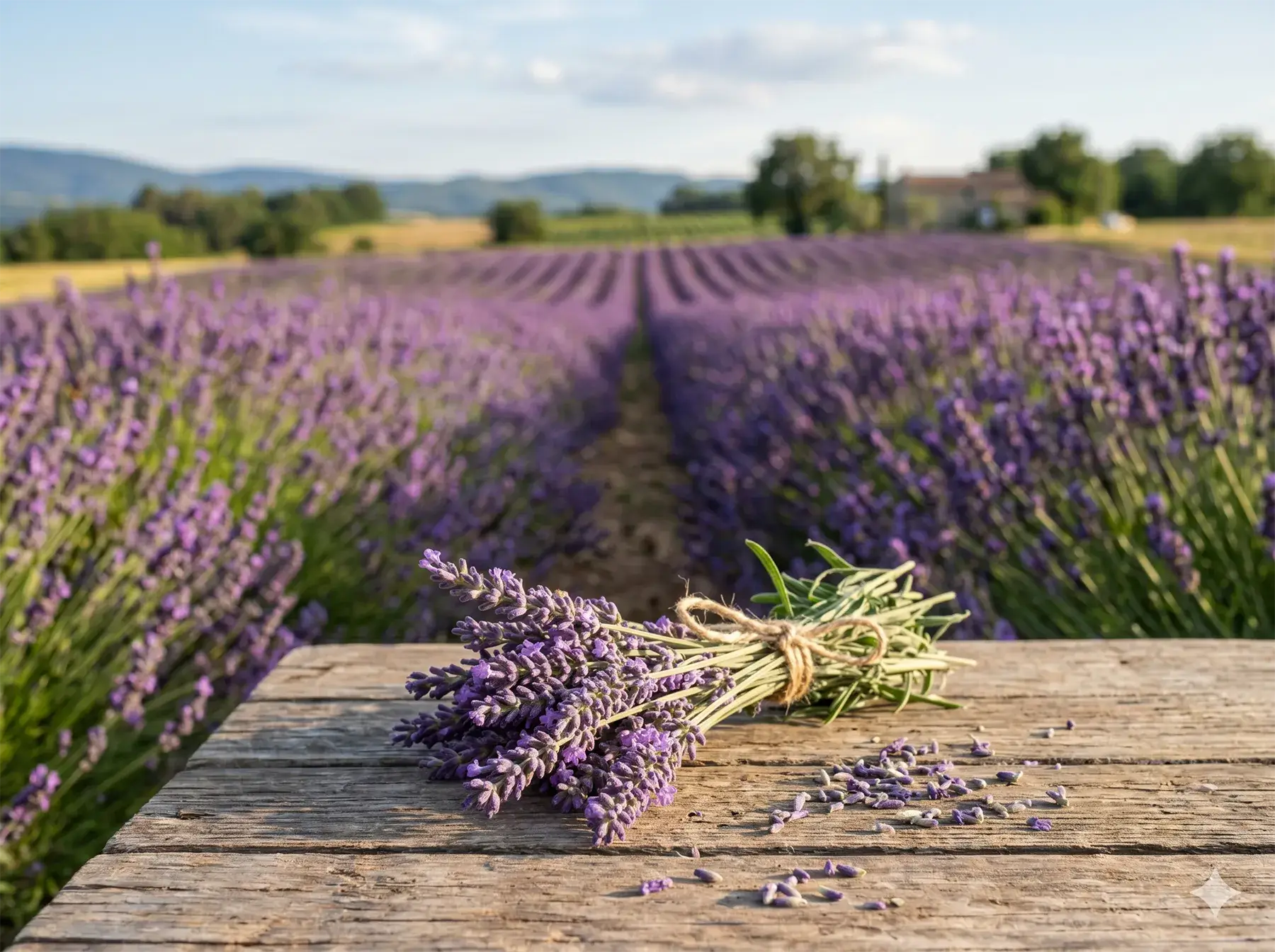
Lavender is one of the most romanticised plants on earth, and one of the most misunderstood. We picture it as something soft and fragile, a postcard of southern France. In truth it is a tough mountain shrub that prefers poor, stony soil, hard sun, and cold winters — pamper it and it sulks; leave it on a dry slope where nothing else wants to grow and it gives you everything. That toughness underneath the perfume is part of what makes it so useful.
This guide cuts through the marketing. It traces lavender from a Roman bathhouse to a modern clinical trial, explains how the oil is actually distilled, sorts out the two species you'll see on shop shelves, and lays out — plainly — what the evidence supports and where caution is wise.
Where the name comes from — and how old this all is
The word lavender descends from the Latin lavare, "to wash." Romans and Greeks used it in their baths and laundry, and the association stuck: lavender's scent reads as clean in a way that settles a room rather than merely masking it. The relationship is genuinely ancient — the Egyptians used lavender in perfumes and in preparing the dead, and the plant appears across classical Mediterranean cultures. Provence didn't invent any of this; it simply kept the habit alive longer and at larger scale than most.
💡 Clean by name — Lavender's clean reputation is literal: its name comes from the Latin word for washing.
The famous burn — and the birth of "aromatherapy"
The modern story turns on a French chemist named René-Maurice Gattefossé. In 1910 an explosion in his laboratory badly burned his hands, and he treated them with lavender oil, noting how well they healed. He spent years studying essential oils and, in 1937, published a book that gave us the word aromatherapy — a French coinage. The romantic embellishments are exaggerations, but the bones are real, and military physicians did use lavender oil to help disinfect wounds during the First World War.
How the oil is actually made
Lavender oil is produced by steam distillation, a method so old it predates Provence's industry by centuries — the physician Avicenna described water-vapour distillation more than a thousand years ago, and the principle hasn't changed, only the copper.
Flowers are packed into a still and steam is passed up through them. The heat opens the oil glands, releasing the oil as a vapour that rises with the steam. That vapour runs through a coil sitting in cold water, where it condenses back into liquid; the oil floats on top and is drawn off. The water left underneath isn't waste — it's hydrosol (floral water), a gentler product used to lightly scent rooms and linens.
What surprises most people is the sheer volume of flower involved. Filling a single litre of true lavender oil takes a large heap of blossom — well over a hundred kilograms, by some accounts close to 200 kg. A little 10 ml bottle represents an armful of hillside, which is exactly why good oil isn't cheap.
True lavender vs. lavandin — the most important distinction
If you remember one thing from this guide, make it this. There are two very different things sold under the lavender name.
True lavender (Lavandula angustifolia)
Also called fine or English lavender, it grows high in the hills and is rich in two gentle, calming compounds — linalool and linalyl acetate. It is the rounder, sweeter, more sleep-friendly oil, and the one you want for relaxation, tender skin, and anything involving children.
Lavandin (Lavandula × intermedia)
A hybrid that grows lower down, it yields far more oil per field (roughly five times as much) and fills most inexpensive bottles and laundry products. It contains much more camphor (around 6–8%, versus well under 1% in true lavender), giving it a sharper, more medicinal character. Good for clearing the head or easing tired muscles — just not the same plant, despite often sharing the same word on a label.
💡 What to buy — Choose angustifolia for calm and skin; lavandin is the sharper, cheaper, camphor-rich cousin — better for muscles than for soothing.
What the science actually says about calm and sleep
Here's where folklore and research meet. A standardised lavender oil preparation taken as an oral capsule (studied under the name Silexan, chemically about 36–37% linalool and 34% linalyl acetate) has been tested in proper clinical trials for anxiety. At 80 mg per day over ten weeks it outperformed placebo and, in head-to-head studies, held its own against medicines such as lorazepam and paroxetine — without the sedation or dependence those drugs can carry.
In a larger trial of 539 adults with generalised anxiety disorder, the higher 160 mg daily dose produced the biggest benefit: around 60% of those patients saw their anxiety scores cut by more than half, compared with roughly 52% on 80 mg, 43% on paroxetine, and 38% on placebo. Separate research suggests it may also help mild-to-moderate low mood. Crucially, this is the oral, standardised preparation used under medical supervision — not the same as sprinkling oil on a pillow, and not something to self-prescribe. For context on the wider (and more mixed) aromatherapy evidence, see this research overview.
That's a meaningfully stronger evidence base than most natural remedies can claim. For everyday poor sleep, the simpler rituals — a few drops on a tissue by the pillow, in a diffuser, or well-diluted in a carrier and massaged into the feet — work less as a sedative than as a signal: a long-learned cue that the day is over and it's safe to let go.
The surprising uses most people miss
Moth repellent. Grandmothers always knew it; chemistry has caught up. The same camphor and 1,8-cineole that make lavandin sharp are disliked by clothes moths, so a sachet of dried lavender in a wool drawer helps protect sweaters with no poison at all.
The kitchen. Only true lavender (L. angustifolia) is used in food, and only sparingly — it's a strong guest. A pinch lifts shortbread, honey, lemonade, and the classic herbes de Provence blend; it pairs beautifully with rosemary on roast lamb.
Bees and a quiet bargain. Provençal beekeepers move hives into the fields, producing a pale, almost creamy lavender honey. The twist: when bees pollinate the flowers well, the plants put more energy into essence — measurements suggest roughly 16–20% more oil on well-pollinated plants. The bee, the flower, and the farmer all profit from the same arrangement.
Using it safely
Natural does not mean harmless — this is a concentrated material, and one drop represents many flowers. A few sensible rules:
- Dilute before skin contact — mix the oil into a carrier (almond, olive, jojoba) and patch-test first.
- Don't ingest it on the strength of internet advice; oral use belongs with standardised preparations and professional guidance.
- Be cautious with very young children, especially boys — favour dried flower or hydrosol over strong oil on the skin.
- See a clinician for real conditions; lavender may support stress and sleep but doesn't replace medical care.
When to harvest, if you grow your own
Cut the flower stems just as the buds begin to open, in the morning after the dew has dried, when oil content is highest. In Provence that window falls in July, after the bees have had their share of the bloom. Distil while the flowers are fresh; the quieter winter that follows is the grower's reward for a patient year.
The short version
- For calm, sleep, and skin choose true lavender (Lavandula angustifolia); lavandin is the cheaper, sharper, camphor-rich hybrid better for muscles.
- The oil is steam-distilled, and it takes well over a hundred kilos of flower per litre — quality oil is never cheap.
- The evidence for lavender easing anxiety is unusually solid for a botanical, thanks to standardised oral preparations studied under medical supervision.
- Dilute, patch-test, don't ingest casually, go gentle around young children, and see a doctor for real conditions.
- Beyond aroma, lavender earns its keep as a moth repellent, a culinary herb, and a honey plant.
Safety note: This article is for general interest and is not medical or veterinary advice. Essential oils are concentrated — dilute before skin use, don't ingest without professional guidance, keep strong oils away from young children's skin, and consult a qualified clinician for anxiety, sleep, or any medical condition. Further reading: Tisserand Institute safety guidelines.
For education only — not medical or veterinary advice. Essential oils are not intended to diagnose, treat, cure, or prevent any condition. Always patch-test and consult a qualified professional before use during pregnancy, on children, with pets, or with a health condition.