Peppermint Oil, Honestly: The Coolest Oil in the Cabinet — and Its Sharp Edges
A grower's-eye guide to peppermint — a sterile hybrid that can only clone itself, the menthol trick that fakes cold, the one use science really backs, and the safety edges that matter most.
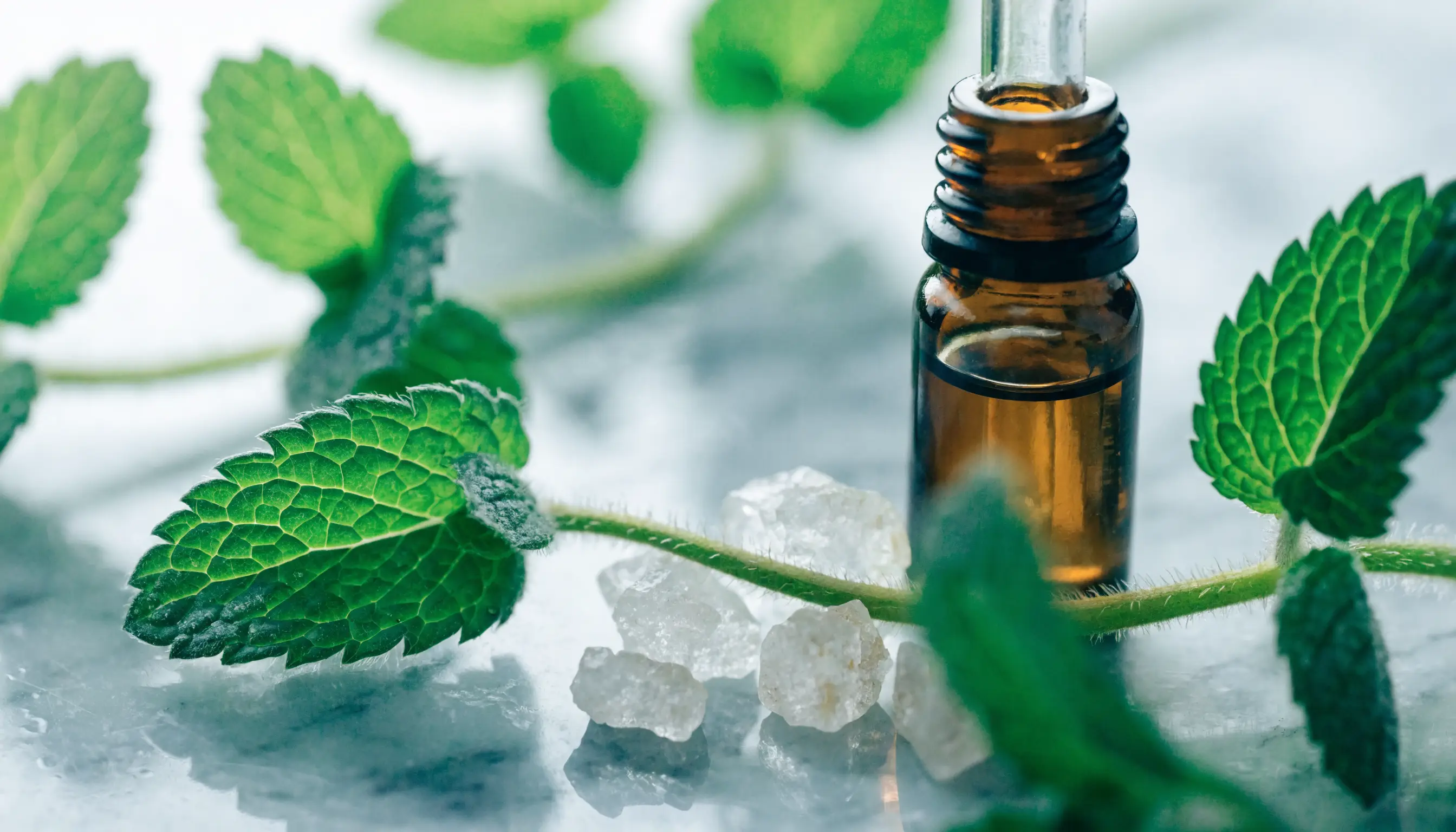
Peppermint is the oil everyone thinks they understand. It smells like clean, like toothpaste and candy canes, like a mouthful of cold air. That familiarity is exactly the problem: because it lives in gum and mouthwash, people treat the essential oil as if it were just as mild. It isn't. Peppermint is one of the most chemically forceful oils on the shelf, and some of its most popular home uses are folklore while its best-evidenced one gets used in ways that are genuinely unsafe.
This is the second entry in our "honestly" series. Like the lavender guide, it traces the plant from its origins to the clinic, explains how the oil is really made, and draws a clear line between what peppermint can do and what it can't.
A plant that can only copy itself
Start with a fact that surprises almost everyone: peppermint isn't a species so much as an accident that stuck. Mentha × piperita is a natural hybrid of watermint (Mentha aquatica) and spearmint (Mentha spicata) — the little "×" in the Latin name is botanical shorthand for "this is a cross" — and the hybrid is sterile. (Comprehensive review of the genus Mentha, 2024)
Because it doesn't set viable seed, it can't be grown the ordinary way. Every peppermint plant on earth is propagated vegetatively — from cuttings, rhizomes and runners — which means cultivated peppermint is essentially one enormous clone, copies of copies of a single lucky cross. Anything sold as "peppermint seed" will grow into some mongrel mint, but not true peppermint. (Mint Genomics Resource, Washington State University)
Botanically it behaves like the rest of the mint family (Lamiaceae): a perennial with the family's signature square stems, roughly 30–90 cm tall, spreading aggressively through underground runners. (Smithsonian Environmental Research Center) That travelling habit is why it's grown in managed fields and why, in a garden bed, it will happily colonise the whole thing.
💡 No such thing as peppermint from seed — Because the hybrid is sterile, true peppermint is only ever grown from cuttings. It's a plant that can copy itself but never breed true.
How the oil is actually made
Peppermint oil is produced by steam distillation of the leaves and flowering herb. (Drugs.com monograph) Steam is passed through the plant material; the heat opens the oil glands, the aromatic vapour rises with the steam, and it condenses back to liquid in a cooled coil, where the oil separates out.
As with lavender, it takes a great heap of plant to fill a small bottle. Peppermint leaf yields only about 0.1–1% volatile oil by weight, so a large mass of herb is distilled per unit of oil. (Drugs.com) The exact yield swings with cultivar, season and how the crop was dried — which is also why no two harvests smell quite identical.
What it actually is — the menthol trick
Here's where peppermint earns its "coolest oil in the cabinet" reputation, and where the honesty has to start. The oil is dominated by menthol — usually somewhere around 30–50% — with menthone (roughly 18–33%) and smaller amounts of menthyl acetate, 1,8-cineole, limonene and a trace of pulegone. Over a hundred components have been identified, and the ratios vary widely with climate, cultivar and season. (Cosmetic Ingredient Review safety assessment)
Menthol is the star, and its famous coolness is a beautiful piece of sensory sleight of hand. It works by activating TRPM8, the same nerve receptor that normally detects genuine cold — active below roughly 26°C, down to about 8°C. When menthol switches TRPM8 on, your skin dutifully reports "cold" even though nothing has actually dropped in temperature. (NCBI Bookshelf — TRPM8: The Cold and Menthol Receptor) There's a lovely detail that seals the point: the cool feeling fades after a while because the receptor desensitises in a calcium-dependent way — the signal adapts even though, again, the temperature never changed at all. (Science Advances, 2024)
This matters beyond the party trick. That cooling — and the "hot" sensation of many topical rubs — is receptor chemistry, not the oil healing tissue or lowering inflammation by temperature. A rub that feels icy is telling your nerves a story; it isn't cooling anything down. (NCBI Bookshelf)
💡 A feeling, not a temperature — Peppermint's coolness is menthol switching on a nerve receptor, not the oil actually chilling your skin. Nothing has cooled down; your nerves have simply been told a convincing story.
A tale of two mints (and two continents)
Peppermint has a proper history, and it's worth getting right because the geography is routinely muddled. Commercial peppermint cultivation centred on Mitcham, in Surrey, from the mid-18th century; by around 1850 the English peppermint industry was at its height before American competition checked it, and the benchmark cultivar "Black Mitcham" still carries the town's name. (Historical text, Project Gutenberg)
The centre of gravity then crossed the Atlantic. True-peppermint production moved to the US Pacific Northwest in the early 20th century — reaching Idaho around 1903 and Oregon's Willamette Valley by 1909, then expanding across Washington and the wider region in the decades that followed — and the United States is today a leading producer of true peppermint oil, grown mainly in Oregon, Washington, Idaho, Indiana and Wisconsin. (HistoryLink.org)
Now the correction almost every article gets wrong: you'll often read that India is the world's biggest peppermint producer. India is the world's largest producer and exporter of mint oil and menthol — supplying roughly 80% of global demand — but that's predominantly cornmint, or menthol-mint (Mentha arvensis), grown largely in Uttar Pradesh. It is not true peppermint. (CSIR, India) India dominates the mint-oil and menthol trade; the US leads true Mentha × piperita. Same word on the label, different plant in the field.
What the science actually supports
This is the section where peppermint quietly outperforms almost every other essential oil — and also where it gets used most dangerously.
The strong evidence: IBS, in capsules, under medical care. Enteric-coated peppermint oil capsules are among the best-evidenced botanical interventions for irritable bowel syndrome. A 2014 systematic review and meta-analysis identified nine randomised trials (726 patients); pooling five of them found peppermint oil significantly better than placebo for overall IBS symptoms (relative risk 2.23), and pooling five for abdominal pain (RR 2.14). (Khanna et al., 2014, J. Clin. Gastroenterology) A larger 2019 meta-analysis of twelve trials and 835 patients reached the same conclusion. (Alammar et al., 2019, BMC Complementary Medicine and Therapies)
Read the specifics before you reach for a bottle. This is an oral, standardised, enteric-coated capsule — the coating exists so the oil survives the stomach and releases lower in the gut — taken for a diagnosed condition, under medical guidance. It is not a cure; it eases symptoms short-term, and even in the trials it came with trade-offs: users were somewhat more likely than placebo to report mild, transient side effects, most commonly heartburn if the oil releases too high up. (Khanna et al.)
Critically, this is completely different from swallowing drops of essential oil. Neat essential oil is highly concentrated and ingesting it can cause real harm; the capsule's whole design is what makes the evidence apply. Please don't read "peppermint helps IBS" as permission to put drops in water or tea — that isn't a smaller version of the same thing, it's an unsafe practice the research never tested. (Tisserand Institute)
💡 The capsule is the point — The IBS evidence is for a standardised, enteric-coated capsule taken under medical care. It says nothing about dropping oil into water or tea, which is a different — and unsafe — thing entirely.
The thinner evidence: tension headache. There is a genuine study here, but keep two things in view — its size, and its concentration. A 1996 randomised, placebo-controlled, double-blind crossover trial applied a 10% peppermint-oil-in-ethanol solution across the forehead and temples, analysing 164 headache attacks in 41 adults, and reported reduced tension-headache intensity versus placebo from 15 minutes on. (Göbel et al., 1996, Nervenarzt) That is one small, older study of a specific research preparation applied under study conditions.
It is emphatically not a how-to. A 10% dilution is roughly ten times the maximum this article recommends for the face (see the safety section below), so it should not be copied at that strength — and the forehead and temples sit right beside the eyes, where menthol vapour and any runoff sting fiercely. Just as importantly: this is a single small trial, not proof that peppermint replaces headache medication. Treat a headache with medical advice, not by dabbing oil near your eyes.
The surprising uses — and the myth to retire
Peppermint is the taste of mint. Beyond aromatherapy, mint is an enormous global commodity: menthol and mint oils flavour toothpaste, chewing gum, confectionery, mouthwash, tobacco and pharmaceuticals worldwide, on a genuinely industrial scale. (CSIR) Most people meet peppermint far more often through their teeth than through a diffuser.
The mouse myth. The internet loves peppermint oil as a natural pest repellent, and it's the claim to treat most sceptically. Mice may dislike the scent and give a freshly treated corner a wide berth, but pest-control professionals are clear that it is not a permanent solution and won't clear an established infestation — the smell fades, has to be reapplied constantly, and does nothing to seal entry points or remove the animals already inside. If you have real mouse activity, that's a job for traps and professional control, not a bottle of oil. (Orkin)
The safety story — read this part twice
Peppermint's sharp edges are real, and a few of them are hard lines rather than gentle cautions.
Never on or near the faces of babies and young children. This is the big one. Menthol- and camphor-rich products applied near a young child's nose or face can cause serious breathing trouble: the research that revealed how these vapour rubs increase airway mucus and hamper its clearance began with a toddler who developed severe respiratory distress after one was smeared under her nose. (Abanses et al., 2009, Chest) Tisserand & Young's Essential Oil Safety is blunt about it — do not apply oils high in menthol or 1,8-cineole to or near the face of infants and children. (Tisserand Institute — kids and inhalation safety) Treat this as a hard line, not a "maybe."
Careful with asthma and reactive airways. The risk isn't only for the very young. Inhaled menthol vapour can irritate the airways and, in susceptible people, aggravate asthma or a reactive airway rather than ease it. If you or anyone in the room has a respiratory condition, don't diffuse peppermint around them without professional advice. (Abanses et al., 2009, Chest)
Risky for cats and dogs. The ASPCA lists mint (Mentha species) as toxic to cats, dogs and horses, with essential oils as the toxic principle. (ASPCA Animal Poison Control) Cats are especially vulnerable: they have far fewer of the liver enzymes needed to metabolise these terpene compounds, so oil can be absorbed through the skin or swallowed during grooming and build up. (VCA Animal Hospitals) Keep peppermint well away from cats entirely, and don't apply or diffuse it around dogs without veterinary guidance.
Dilute — it's a known irritant. Peppermint is a recognised skin irritant and sensitiser at higher concentrations, so it must be well diluted before it touches skin. (Cosmetic Ingredient Review) Keep it low — around 1–2% is plenty for most uses, and even short-term topical use should stay well under the theoretical maximum — and let a dilution calculator do the arithmetic rather than eyeballing drops. Whatever the percentage, keep it away from the eyes, nostrils and other mucous membranes, where even a well-diluted menthol oil stings sharply, and approach any facial use of a menthol-rich oil cautiously. You can see peppermint's full profile, including its exact dilution maxima and its high-menthol flag, on its oil page.
Not during pregnancy or nursing without professional advice. Peppermint is commonly advised to be avoided in pregnancy and breastfeeding unless a qualified professional says otherwise. (Drugs.com) That's the whole guidance — not a dose to try.
The short version
- Peppermint (Mentha × piperita) is a sterile hybrid of watermint and spearmint, propagated only by cuttings — there's no such thing as true peppermint from seed.
- Its coolness is menthol activating the TRPM8 cold receptor: a sensory trick, not real cooling or healing.
- The US leads true peppermint; India leads the mint/menthol trade — but that's mostly cornmint (Mentha arvensis), a different plant.
- The strong evidence is for enteric-coated capsules easing IBS symptoms short-term under medical care — which is nothing like swallowing drops of oil. Headache evidence is thin: one small study of a 10% research preparation, far stronger than any safe home dilution.
- The pest-repellent reputation is largely folklore; it won't clear an infestation.
- Keep it away from babies' and young children's faces, cautious around asthma, away from cats, cautious around dogs, well diluted and clear of the eyes, and off-limits in pregnancy without professional advice.
Safety note: This article is for general interest and is not medical or veterinary advice. Essential oils are concentrated — dilute before skin use, never ingest them on the strength of online advice, keep menthol-rich oils away from the faces of infants and young children and away from anyone with a respiratory condition, keep them away from pets (especially cats), and consult a qualified clinician or vet for any medical condition. Further reading: Tisserand Institute safety guidelines.
For education only — not medical or veterinary advice. Essential oils are not intended to diagnose, treat, cure, or prevent any condition. Always patch-test and consult a qualified professional before use during pregnancy, on children, with pets, or with a health condition.