The Perfumer's Score — How to Compose a Blend, Not Just Mix Oils
Top, middle, and base notes, the ratios that work, and recipes for every season, room, and mood.
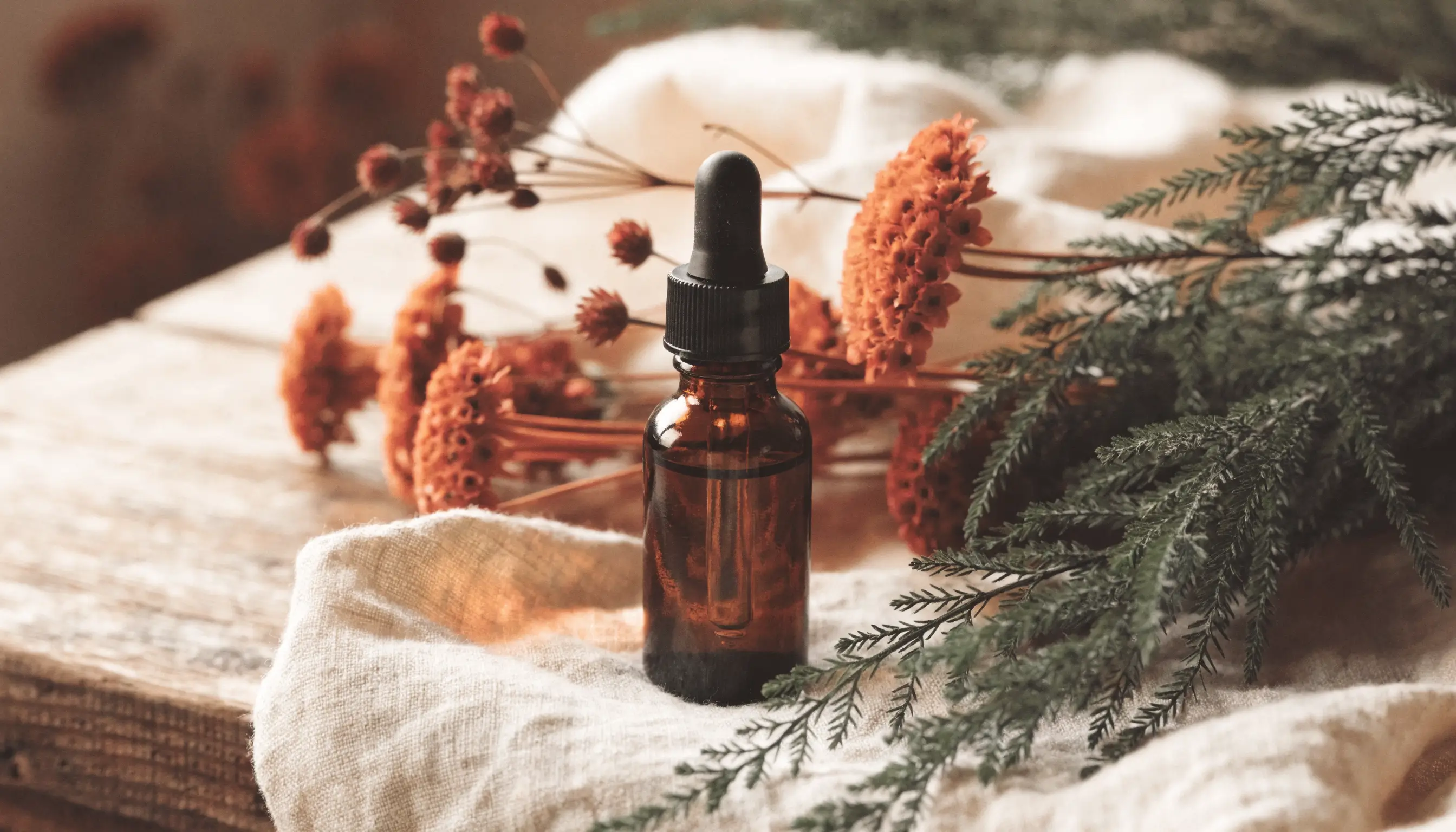
If a single essential oil is one musical note, a blend is a chord. The best aromatherapy isn't louder than a single oil — it's richer, longer, and more complete. The framework that makes that possible has a long history in perfumery and still maps cleanly onto a 10 ml roller bottle on your nightstand.
This guide covers the three-note structure every blend lives in, the simple ratios to start from, the safety rails that should run alongside your creativity, and a small library of ready-to-use recipes for seasons, rooms, and daily routines.
The Three Notes — What's Actually Going On
A blend evolves over time. What you smell at minute one is rarely what you smell at minute thirty. That's because different essential-oil molecules have different evaporation rates, and they don't take the stage at the same moment.
Top notes — the first impression
Bright, sharp, fleeting. They tend to evaporate first — often within an hour or two. They sell the blend the moment someone walks past you, then quietly hand off to the middle notes.
Common tops: lemon, grapefruit, bergamot, sweet orange, peppermint, eucalyptus.
Middle notes — the heart
The body of the blend. They emerge as the tops fade and generally last a few hours. Most of the personality of a blend — its mood and signature — lives here.
Common middles: lavender, rosemary, geranium, clary sage, chamomile, tea tree.
Base notes — the anchor
Deep, rich, persistent. They can linger far longer than the tops. Bases give a blend longevity and a sense of dimension. Without them, your composition is bright but thin.
Common bases: sandalwood, cedarwood, vetiver, frankincense, patchouli, vanilla. (A note on vanilla: it isn't a steam-distilled essential oil — it reaches you as an absolute or CO2 extract. Lovely to blend with, just not the same category as a distilled oil.)
A starting ratio
A balanced blend often starts at roughly 30 % top, 50 % middle, 20 % base. That's not a rule — it's a runway. Once you've felt the shape of a 30/50/20 blend, you'll start moving the dials and finding the version that's yours.
💡 Try it without the calculator. Perfumer's Studio lays the three notes out as separate zones — top, heart, base — and shows you the balance live as you drop oils in, with built-in suggestions for complementary notes when you get stuck.
Before You Mix — Safety in Two Minutes
A blend isn't ready to wear until it's diluted. A few quick checks:
- A common adult starting point is about 2 % for a body roller (≈ 12 drops per 30 ml of carrier, or about 4 drops in a 10 ml roller). Treat this as a starting point, not a universal standard — each oil has its own maximum, and the lower number always wins (see general safety guidance).
- Face: 1 % or less, and keep sharp oils like peppermint and eucalyptus away from the face and eyes entirely.
- Around young children: dilute far lower, and keep peppermint and eucalyptus away from little faces — they're contraindicated near infants' and young children's faces.
- Phototoxicity depends on the oil, how it was extracted, and its finished concentration — not just a waiting time. Cold-pressed (expressed) citrus like bergamot, lime, bitter orange and lemon can react with sunlight on skin; steam-distilled or bergapten-free (FCF) versions behave differently. Grapefruit is milder than bergamot or lime. Keep expressed citrus out of leave-on products worn on exposed skin unless it's within the IFRA phototoxicity limit for that oil.
- Pregnancy: check each oil individually with a qualified professional before use.
- Pets: cats, birds and other animals process these compounds differently, and some essential oils can harm them — see the room notes below.
This is general information, not medical or veterinary advice. If you're pregnant, managing a health condition, or unsure about an oil, consult a qualified professional.
💡 If this is a lot to track, Quick Blend helps you keep an eye on it — pick the delivery method, and it flags oils that conflict with your saved cautions before you save.
Keep a blending notebook. Drops, carrier, date, mood, what you smelled at 5 minutes vs. 2 hours. The blends you'll want to remake are the ones you wrote down.
Seasonal Blends
These are diffuser recipes — total drops for a diffuser, not a skin dilution. Diffuser proportions do not transfer directly to a roller: a handful of drops in a 10 ml roller lands well above a safe skin dilution, and any expressed-citrus blend below would be phototoxic on skin. If you want a roller version, recompose it from scratch at ≤ 2 % and within each oil's own limit (see the mood rollers below).
🌱 Spring Awakening — 3 lemon + 2 eucalyptus + 2 lavender. Clean, floral, the smell of opening a window after a long winter.
☀️ Summer Citrus Burst — 3 grapefruit + 2 lime + 2 peppermint. Bold and cooling in the air. Diffuser only — don't turn this into a skin mist; the expressed citrus is phototoxic on skin.
🍂 Autumn Spice — 3 cinnamon bark + 2 sweet orange + 2 clove bud. Hot apple cider in aromatic form. Diffuser only. Cinnamon bark and clove bud have very low dermal limits (well under a 1 % roller) — never use this blend on skin.
❄️ Winter Comfort — 3 frankincense + 2 cedarwood + 2 tea tree. Grounding, meditative, with a clean woodsmoke depth. Tea tree and similar oils can be harmful to cats and other pets — diffuse in a ventilated room and keep pets able to leave.
Roller Blends for Every Mood
10 ml amber or cobalt glass rollers, filled with fractionated coconut oil as the carrier. Each recipe below is 4 drops total ≈ 2 % — a common adult starting dilution. Patch test first on the inner forearm; a patch test flags an immediate reaction but doesn't rule out sensitivity developing later, so keep dilutions modest.
- Calm & Serenity — 2 lavender + 1 bergamot (FCF/bergapten-free) + 1 ylang ylang. Wrists and behind the ears. Use bergapten-free (FCF) bergamot — ordinary expressed bergamot is phototoxic in a leave-on product on exposed skin.
- Morning Energy — 2 peppermint + 1 sweet orange + 1 rosemary. Wrists only — keep peppermint away from the face and eyes. A caffeine-free wake-up.
- Deep Sleep — 2 cedarwood + 1 lavender + 1 vetiver. Soles of the feet, about twenty minutes before bed.
- Cool Comfort — 1 peppermint + 2 lavender + 1 frankincense. Back of the neck and shoulders — not temples or forehead, and keep peppermint away from the eyes. A cooling moment when you want to unwind.
- Bright Clean — 1 tea tree + 1 eucalyptus + 2 lemon. Chest only. Expressed lemon is phototoxic — keep the area covered or out of the sun, or choose steam-distilled lemon. Not for use near young children (eucalyptus).
Stop and wash the area with a plain carrier oil if any redness, heat, or itching appears.
Diffuser Recipes Room by Room
Around 5–8 drops per session is a common practice, not a required dose — start low and let your nose tell you. Diffuse intermittently (roughly 30 minutes on, 30 minutes off) in a ventilated room, keep the diffuser away from pets, birds and young children, and stop if anyone in the room feels irritation, a headache, or watery eyes. Birds are especially sensitive to airborne compounds.
| Room | Blend | Total drops |
|---|---|---|
| Living Room — Warm Welcome | 3 sweet orange + 2 cedarwood + 1 vanilla | 6 |
| Kitchen — Fresh Clean | 3 lemon + 2 peppermint + 1 rosemary | 6 |
| Bedroom — Sleep Sanctuary | 3 lavender + 2 chamomile + 1 sandalwood | 6 |
| Home Office — Laser Focus | 3 rosemary + 2 lemon + 1 basil | 6 |
| Bathroom — Spa Escape | 3 eucalyptus + 2 lavender + 1 tea tree | 6 |
A diffused scent freshens the air you notice — it isn't a substitute for ventilation or cleaning, and it doesn't disinfect a room.
The Four-State Daily System
One of the nicest ways to use blends isn't a single recipe — it's a rhythm. Pair each blend with a moment, consistently, so the scent becomes a familiar cue.
- Morning Energy at the start of the day.
- Laser Focus through deep work.
- Calm & Serenity when stress spikes.
- Deep Sleep as the wind-down.
Repeat over a few weeks and many people find the scent itself becomes a small ritual — a signal that helps them settle into the moment. It's association, not medicine; enjoy it for what it is.
💡 Did you know?
The "top–middle–base" framework was popularised by an English perfumer. In the mid-1800s, G. W. Septimus Piesse wrote about arranging fragrances like notes on a musical staff — light scents as high notes, heavy ones as low (Wellcome Collection). A century and a half later, the metaphor is still one of the most useful tools an essential-oil blender has.
A Few Quiet Facts From the History
- The oldest recorded perfumer we know by name is Tapputi-Belatekallim, a Mesopotamian woman whose perfume methods were inscribed on cuneiform tablets. Her approach — steeping, distilling and filtering aromatic plants — is an early ancestor of the extraction methods still used today.
- Aromatherapists often suggest the soles of the feet for roller blends. The reason usually given (huge pores, fast absorption) isn't quite right — the soles are actually some of the thickest skin on the body, which makes them a bit less prone to irritation than thin skin on the wrists or neck. That's the sensible case for using them, especially at bedtime.
Where to Take This Next
A blend you actually use is worth ten beautiful blends sitting in a drawer. Pick one from the four-state system, build it tonight, and let it find its place in your week. The chord gets richer every time you play it.
New to all this? Read Powerful, Not Gentle — A Realistic Safety Guide first, then come back and compose.
Safety note: This article is general information, not medical or veterinary advice. Essential oils are concentrated plant extracts — patch test, dilute within each oil's own limit, keep them away from pets, birds and young children, and consult a qualified professional if you're pregnant, managing a health condition, or unsure.
References
For education only — not medical or veterinary advice. Essential oils are not intended to diagnose, treat, cure, or prevent any condition. Always patch-test and consult a qualified professional before use during pregnancy, on children, with pets, or with a health condition.