The Art & Science of Essential Oil Blending
How to actually compose a blend — top, middle and base notes, ratios that work, and roller and diffuser recipes for every season.
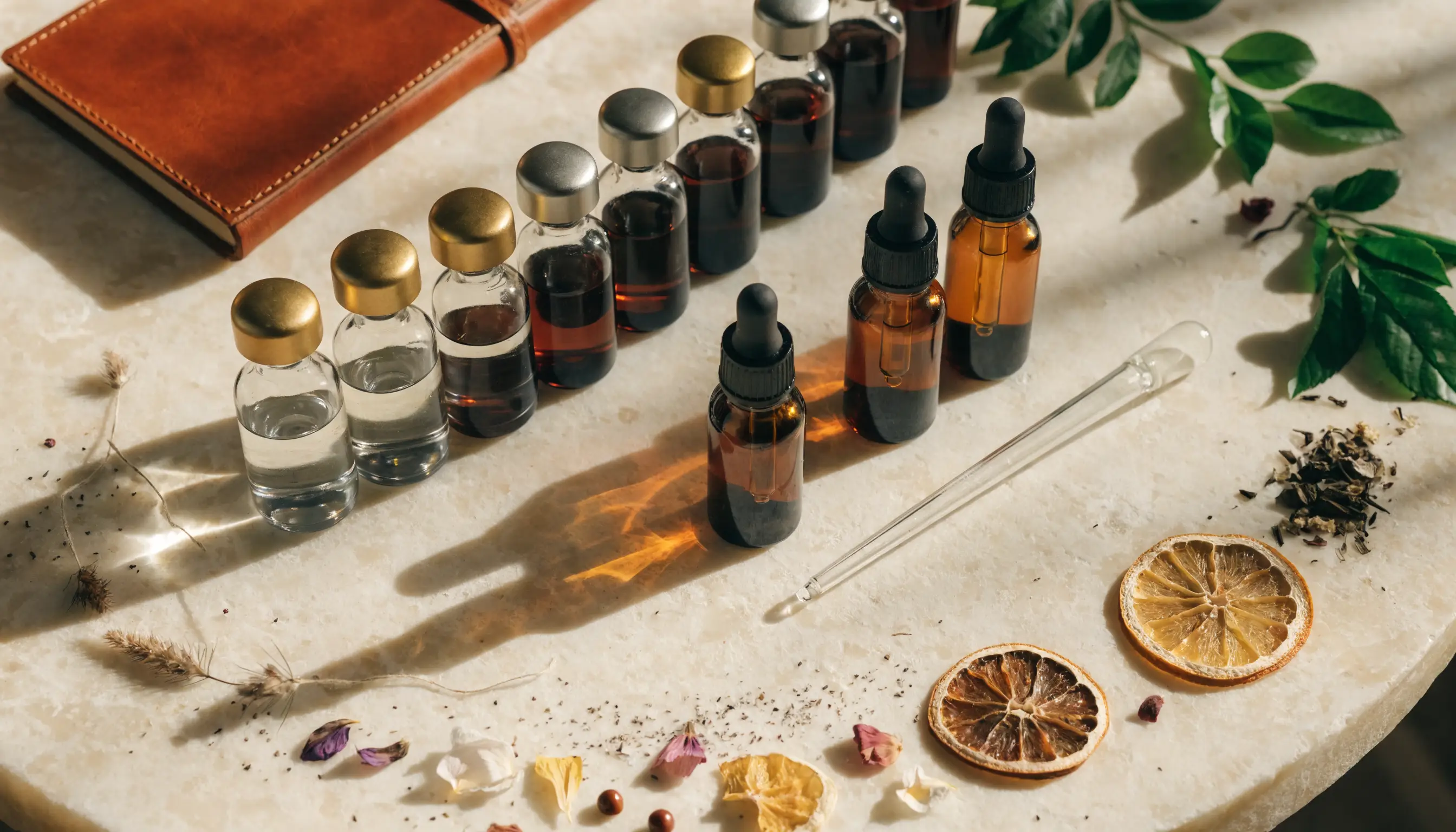
If using a single essential oil is like playing a single musical note, blending is like composing a small piece of music. When oils are combined thoughtfully, their aromatic profiles complement one another, creating experiences that are richer and more layered than any single oil alone. Blending is part craft, part chemistry, and part practical skill — understanding scent character, respecting safety limits, and measuring carefully.
This guide covers foundational blending ideas plus ready-to-use diffuser and roller recipes. It is about scent and enjoyment, not treatment. Nothing here is medical or veterinary advice; if you have a health concern, are pregnant or breastfeeding, or are blending for a child or someone with a medical condition, consult a qualified professional first.
Understanding Scent Notes
The top/middle/base "note" system is a creative convention borrowed from perfumery, not a fixed law of chemistry. It's a useful way to think about how a blend unfolds, even though real oils are complex mixtures whose components evaporate across a wide, overlapping range rather than in three tidy bands.
Top notes are the scents you tend to notice first — bright, sharp and fleeting. Citrus oils like lemon, grapefruit, bergamot and sweet orange are usually treated as top notes, along with peppermint and eucalyptus.
Middle notes are often described as the "heart" of a blend, giving it body and character as the brighter top notes fade. Lavender, rosemary, geranium, clary sage, chamomile and tea tree are commonly used here.
Base notes are deep, rich and long-lasting, and tend to anchor a blend. Sandalwood, cedarwood, vetiver, frankincense and patchouli are classic base notes. (Vanilla is often grouped here too, though vanilla is typically an absolute or CO2 extract rather than a steam-distilled essential oil.) A common starting point for a balanced blend is roughly 30% top, 50% middle and 20% base notes — a guideline to play with, not a rule.
Safety Rules for Blending
Before any creative work begins, set your safety limits.
Dilution. For adult topical use, around 2% is a common starting point — roughly 12 drops per 30 ml (1 oz) of carrier — but it is not a universal standard. Every oil has its own maximum, and the oil's own limit always overrides the 2% figure. Some oils (for example cinnamon bark and clove bud) are safe only at fractions of a percent and are best kept out of leave-on rollers entirely. See the Tisserand Institute safety guidelines for oil-specific maxima.
Children. Blending for children is not just "use less." Some oils are best avoided altogether at young ages, and peppermint and eucalyptus in particular should be kept away from the faces of babies and young children. Get individual guidance from a qualified professional rather than assuming a topical blend is fine.
Phototoxicity. Some citrus oils can react with sunlight (UV) and cause burns or dark marks. This depends on how the oil was extracted and its finished concentration, not simply on a wait-time. Cold-pressed (expressed) bergamot is strongly phototoxic — its leave-on limit is very low (around 0.4% per IFRA) — while lime and bitter orange are also of concern; grapefruit is milder. Steam-distilled or bergapten-free "FCF" citrus behaves differently. The simplest safe rule: don't put expressed citrus in a leave-on product on sun-exposed skin. More detail: Tisserand on phototoxicity.
Pregnancy and health conditions. Some oils carry cautions in pregnancy or with certain conditions or medications. Rather than relying on a fixed "avoid" list, check with a qualified professional for your situation.
Patch testing. Applying a small diluted amount to your inner forearm and waiting 24 hours can reveal an immediate reaction. It is a sensible habit, but it does not guarantee you won't become sensitised to an oil later with repeated use.
Keep away from eyes and mucous membranes. Never apply blends near the eyes, inside the nose, or on other mucous membranes, and wash your hands after applying.
Keep a blending journal. Record every recipe — exact drops, the carrier used, and your impressions of the scent. This turns random experimentation into knowledge that improves your blending over time.
Seasonal Diffuser Blends
These are fragrance blends for a diffuser. Follow the general diffuser guidance further down (intermittent use, ventilation, and keeping oils away from pets, birds and young children).
Spring Awakening: 3 drops lemon + 2 drops eucalyptus + 2 drops lavender. Clean, green and bright — pleasant for airing out rooms after winter.
Summer Citrus: 3 drops grapefruit + 2 drops lime + 2 drops peppermint. Bold and zesty for warm afternoons. (Diffuse only — this is not a body mist. Essential oils don't dissolve in water, and witch hazel or plain water won't disperse them safely on skin.)
Autumn Spice: 3 drops cinnamon bark + 2 drops sweet orange + 2 drops clove bud. Warm and spiced, like cider in the air. Lovely diffused during dinners or cosy evenings. (Cinnamon and clove are skin irritants at very low thresholds — enjoy these two by diffusion only, not on skin.)
Winter Woods: 3 drops frankincense + 2 drops cedarwood + 2 drops sweet orange. Grounding and warm, with a soft woody character for evening wind-down.
DIY Roller Blend Recipes
Roller bottles are a portable, practical format for scented skin blends. These use 10 ml amber or cobalt glass rollers filled with fractionated coconut oil. To stay at roughly 2% or below in a 10 ml roller, keep the total to about 4 drops, and keep each oil within its own limit. Apply to the body area named, avoid the eyes and face, and stop if you notice any irritation.
Calm & Serenity: 2 drops lavender + 1 drop bergapten-free (FCF) bergamot + 1 drop ylang ylang, in 10 ml carrier (~2%). Apply to wrists and behind the ears. Use only FCF/bergapten-free bergamot here — expressed bergamot is phototoxic and does not belong in a leave-on wrist or behind-the-ear roller.
Morning Bright: 2 drops peppermint + 1 drop sweet orange + 1 drop rosemary, in 10 ml carrier (~2%). Roll onto forearms and wrists — not the temples or face, since peppermint should be kept well away from the eyes. (Sweet orange is not among the phototoxic citrus oils.)
Restful Evening: 2 drops lavender + 1 drop cedarwood + 1 drop vetiver, in 10 ml carrier (~2%). A grounding, woody blend traditionally used as part of a wind-down routine; apply to the soles of the feet and the chest.
Neck & Shoulder Comfort: 2 drops lavender + 1 drop frankincense + 1 drop peppermint, in 10 ml carrier (~2%). Apply to the back of the neck and shoulders only — keep it away from the forehead, temples and eyes.
Woodland Fresh: 2 drops cedarwood + 1 drop tea tree + 1 drop lemon, in 10 ml carrier (~2%). A fresh, foresty scent for cooler months; apply to the chest or soles of the feet (covered skin, not sun-exposed, because expressed lemon can be phototoxic). This is a fragrance blend only, not a remedy — it doesn't treat colds or "support immunity." Note that tea tree and eucalyptus-type oils should be kept away from young children.
Diffuser Recipes Room by Room
Living Room — Warm Welcome: 3 drops sweet orange + 2 drops cedarwood + 1 drop vanilla (absolute/CO2). Warm and inviting for shared spaces.
Kitchen — Fresh & Bright: 3 drops lemon + 2 drops peppermint + 1 drop rosemary. A clean, lively scent that pairs well with a well-ventilated kitchen.
Bedroom — Sleep Sanctuary: 3 drops lavender + 2 drops chamomile + 1 drop sandalwood. Start about 30 minutes before bed using an auto-shutoff timer.
Home Office — Clear Desk: 3 drops rosemary + 2 drops lemon + 1 drop basil. A crisp, herby scent for focused work sessions.
Bathroom — Spa Fresh: 3 drops eucalyptus + 2 drops lavender + 1 drop tea tree. Clean and green for a spa-like mood.
For every diffuser blend: use about 5–8 total drops per session and diffuse intermittently — roughly 30 minutes on, 30 minutes off — in a ventilated room to avoid olfactory fatigue and reduce buildup. Keep diffusers well away from pets, especially cats and birds: oils such as tea tree, eucalyptus, peppermint and citrus can be harmful to them, and cats process some of these compounds poorly. Keep diffusion out of spaces used by young children, and stop if anyone (human or animal) shows any sign of irritation. See ASPCA guidance on essential oils around pets and the Tisserand Institute on cats.
The Four-State Daily Ritual
One enjoyable way to use blends is as a set of scent cues through the day: a bright blend in the morning, a crisp one during focused work, a calming one when things get hectic, and a soft, woody one in the evening. Over time, many people find a particular scent becomes a familiar signal they associate with a certain mood or activity — a personal ritual rather than a treatment.
Interesting Facts
The top-middle-base note framework was popularised in the nineteenth century by the English perfumer and chemist G.W. Septimus Piesse, who drew an analogy between scent and music and even arranged fragrances on a musical staff — lighter scents as high notes, heavier ones as low. Blenders still borrow the idea today. (See his work archived at the Wellcome Collection.)
Aromatic and botanical practice has a long history across many cultures — perfumers, healers and craftspeople have blended fragrant plant materials for thousands of years, long before modern distillation and extraction methods existed.
Many aromatherapists like to apply roller blends to the soles of the feet. The reason usually given is simply that the skin there is thicker and generally less prone to irritation than delicate areas like the wrists or neck — a comfort consideration, not a claim about faster absorption.
Safety note: This article is for general fragrance and wellbeing enjoyment only. It is not medical or veterinary advice, and essential oils are not a treatment for any condition. Always dilute correctly, respect each oil's own limits, keep oils away from eyes, young children and pets, and consult a qualified professional if you are pregnant, breastfeeding, unwell, or blending for someone with a health condition.
References
For education only — not medical or veterinary advice. Essential oils are not intended to diagnose, treat, cure, or prevent any condition. Always patch-test and consult a qualified professional before use during pregnancy, on children, with pets, or with a health condition.