Tea Tree Oil, Honestly: The Medicine-Cabinet Staple That Isn't a Cure-All
A clear-eyed guide to tea tree — where it really comes from, why an old bottle is riskier than a fresh one, what it's genuinely useful for, and the safety edges (pets, ingestion) that matter most.
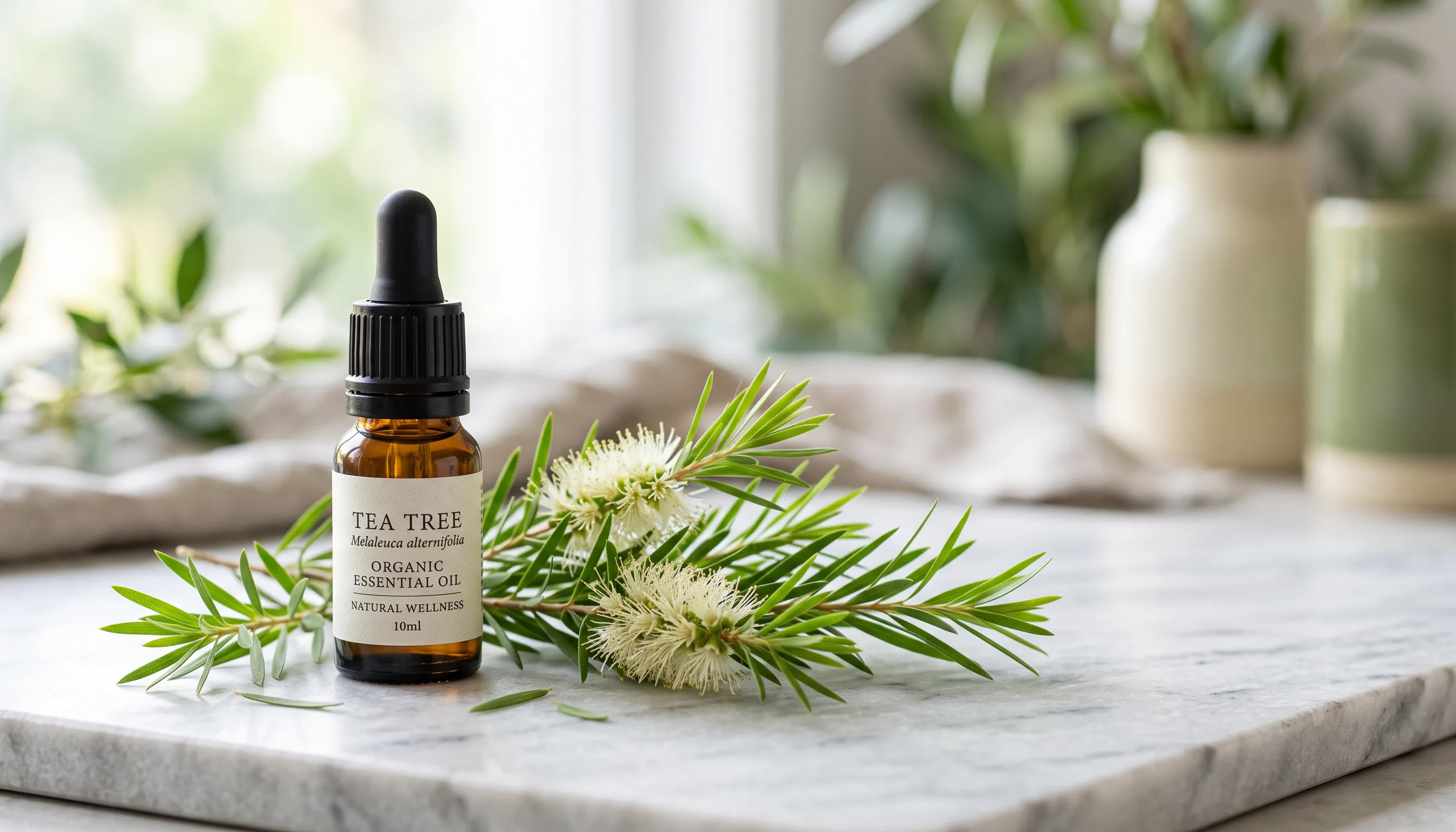
Tea tree is the oil people trust the most and understand the least. It lives in the bathroom cabinet next to the plasters, it's dabbed on spots and stirred into cleaning sprays, and it carries a reputation as a do-everything antiseptic. Some of that reputation is earned. A lot of it is marketing — and one very common habit, keeping the same bottle for years, quietly turns tea tree from a fairly gentle oil into one of the more likely to irritate your skin.
This is the next entry in our "honestly" series. Like the lavender and peppermint guides, it walks from the plant to the bottle and draws a clear line between what tea tree can do and what it can't.
A single tree, on the other side of the world
Tea tree oil comes from Melaleuca alternifolia, a paperbark shrub native to north-eastern New South Wales and south-eastern Queensland, Australia. Despite the name, it has nothing to do with the tea you drink — the "tea tree" label is usually traced to early European arrivals who reportedly brewed local leaves into a tea-like infusion, though that origin story is more folk-history than firmly documented.
The oil is produced by steam distillation of the leaves and fine twigs: steam is passed through the foliage, the heat releases the aromatic compounds, and they condense back into a liquid that separates from the water. Australia remains the heartland of true Melaleuca alternifolia production, and — as with most essential oils — the exact aroma and composition shift with the plantation, the season and the harvest.
💡 Not a "tea," not one plant — Lots of different plants get called "tea tree." Aromatherapy tea tree oil is essentially always Melaleuca alternifolia, but its close cousins in the same Melaleuca genus — cajeput (M. cajuputi) and niaouli (M. quinquenervia) — are distinct oils with their own profiles, and manuka is a different plant again. Read the Latin name, not just the words "tea tree."
What it actually is — and why age matters
Tea tree's character comes mostly from a compound called terpinen-4-ol, alongside a supporting cast of other terpenes. An international standard (ISO 4730) sets expected ranges for the key components — which is a clue to what "quality" really means here. The useful signal isn't price; it's evidence: clear botanical identity, a batch GC–MS profile and ISO compliance, rather than how much the bottle cost.
Here's the part almost nobody is told, and it's the single most useful thing in this article: tea tree oil oxidises. Exposed to air, light and warmth, some of its components break down into new ones — and those oxidation products are more likely to irritate and sensitise skin than the fresh oil. Tisserand & Young's Essential Oil Safety is explicit that oxidised tea tree is a greater skin risk than fresh, and recommends storing it cool, dark and tightly closed, and not keeping it too long. (Tisserand Institute — safety guidelines) That said, "fresh" is not the same as "harmless": even fresh, good-quality tea tree is classed as a moderate skin sensitiser and causes an allergic reaction in a small number of people. Oxidation raises that risk — it doesn't invent it.
In plain terms: an old, air-exposed bottle is riskier than a fresh one. There's no magic expiry date — how fast it degrades depends on light, warmth, how full the bottle is and how often it's opened — so buy small amounts, note the date you open it, store it cool and dark with the lid tight, and retire it if it smells sharp, turpentine-ish or simply "off." A smell test can catch clearly bad oil, but it can't certify that oil is still good.
💡 Old tea tree is riskier — but fresh isn't risk-free — Oxidised tea tree causes more skin reactions than fresh, yet even fresh oil is a recognised sensitiser for some people. Buy small amounts, store it cool and dark, keep the lid tight, note the opening date, and replace it rather than hoarding it.
What it's genuinely useful for — and what it isn't
Tea tree is one of the more studied essential oils, and it has real, long-standing use in skincare and household products. But there's a wide gap between "traditionally used for" and "a treatment," and honesty means keeping that gap visible.
- In skincare and cosmetics, tea tree is a hugely popular ingredient, especially in products aimed at blemish-prone skin. Where it's actually been studied for skin uses, the evidence is limited and specific to particular products; for most other popular uses it's thin. A cosmetic ingredient is not a medicine, and a spot regimen is not the same as treating a skin condition. If something on your skin is painful, spreading, or not settling, that's a job for a pharmacist or doctor, not a bottle of oil.
- As a household cleaner, its fresh, medicinal scent makes it a popular addition to homemade sprays and surface wipes. Useful and pleasant — just remember a nice-smelling spray is not a hospital-grade disinfectant, and shouldn't be treated as one.
What tea tree is not is an internal remedy or an all-purpose antiseptic you can reach for in place of medical care. The most important line in the whole piece is the next one.
The safety story — read this part twice
Never swallow it. This is the hard line. Tea tree oil is genuinely toxic if ingested — even small amounts can cause serious effects, and poison-control and veterinary bodies treat ingestion as an emergency. It is for external, diluted use only. Keep the bottle well out of reach of children, and never take it internally "for immunity" or anything else. (Tisserand Institute — safety guidelines)
Genuinely dangerous for cats and dogs. Tea tree is, in fact, one of the essential oils most often reported in pet poisonings. Cats are especially vulnerable — they're missing much of the liver "glucuronidation" machinery other animals use to break these compounds down — and both cats and dogs can be harmed by oil that's licked, spilled, or absorbed through the skin, not only swallowed. (Merck Veterinary Manual — essential-oil toxicoses in animals; VCA Animal Hospitals — essential-oil poisoning in cats; ASPCA Animal Poison Control) Don't apply tea tree to pets, don't use pet products containing it without veterinary guidance, and keep diffusing and open bottles well away from animals.
Dilute, and skin-test — especially older oil. You'll sometimes see tea tree used "neat" (undiluted) on a single spot. Given the sensitising risk above, the safer default is to dilute it into a carrier oil and do a small skin test on your inner forearm first — apply a little, leave it a day or two, and watch for any reaction before using it more widely. Bear in mind this home check lowers the risk but doesn't remove it: an allergy can develop only after repeated use, and a true diagnostic patch test is a medical procedure. Keep it well away from the eyes and other mucous membranes. Let a dilution calculator do the arithmetic, and check tea tree's full profile and dilution guidance on its oil page.
Pregnancy, nursing and young children — get advice. As with any concentrated oil, don't use tea tree in pregnancy or breastfeeding, or on young children, without guidance from a qualified professional.
The short version
- Tea tree oil is steam-distilled from Melaleuca alternifolia, a paperbark native to northern New South Wales — unrelated to drinking tea, and different from other "tea tree" oils like cajeput and niaouli.
- Its key component is terpinen-4-ol, but the headline safety fact is that tea tree oxidises: an old, air-exposed bottle is more irritating and sensitising than a fresh one — though even fresh oil can trigger a reaction in some people. Store it cool and dark, note when you opened it, and replace it.
- It's a genuinely popular skincare and cleaning ingredient — but "commonly used for" is not "treats," and it's no substitute for medical care.
- Never ingest it. It's toxic if swallowed.
- It's dangerous to cats and dogs — keep it away from pets entirely.
- Dilute, patch-test, keep it clear of the eyes, and get professional advice for pregnancy, nursing or young children.
Safety note: This article is for general interest and is not medical or veterinary advice. Essential oils are concentrated — dilute before skin use, never ingest them, keep them away from pets (especially cats), replace oxidised oil, and consult a qualified clinician or vet for any medical concern. Further reading: Tisserand Institute safety guidelines.
For education only — not medical or veterinary advice. Essential oils are not intended to diagnose, treat, cure, or prevent any condition. Always patch-test and consult a qualified professional before use during pregnancy, on children, with pets, or with a health condition.