Can You Put Essential Oils in a Christmas Simmer Pot?
We'd leave essential oils out of a Christmas simmer pot. A peel-and-spice recipe, how to supervise it, keeping pets away, and a stove-free option.
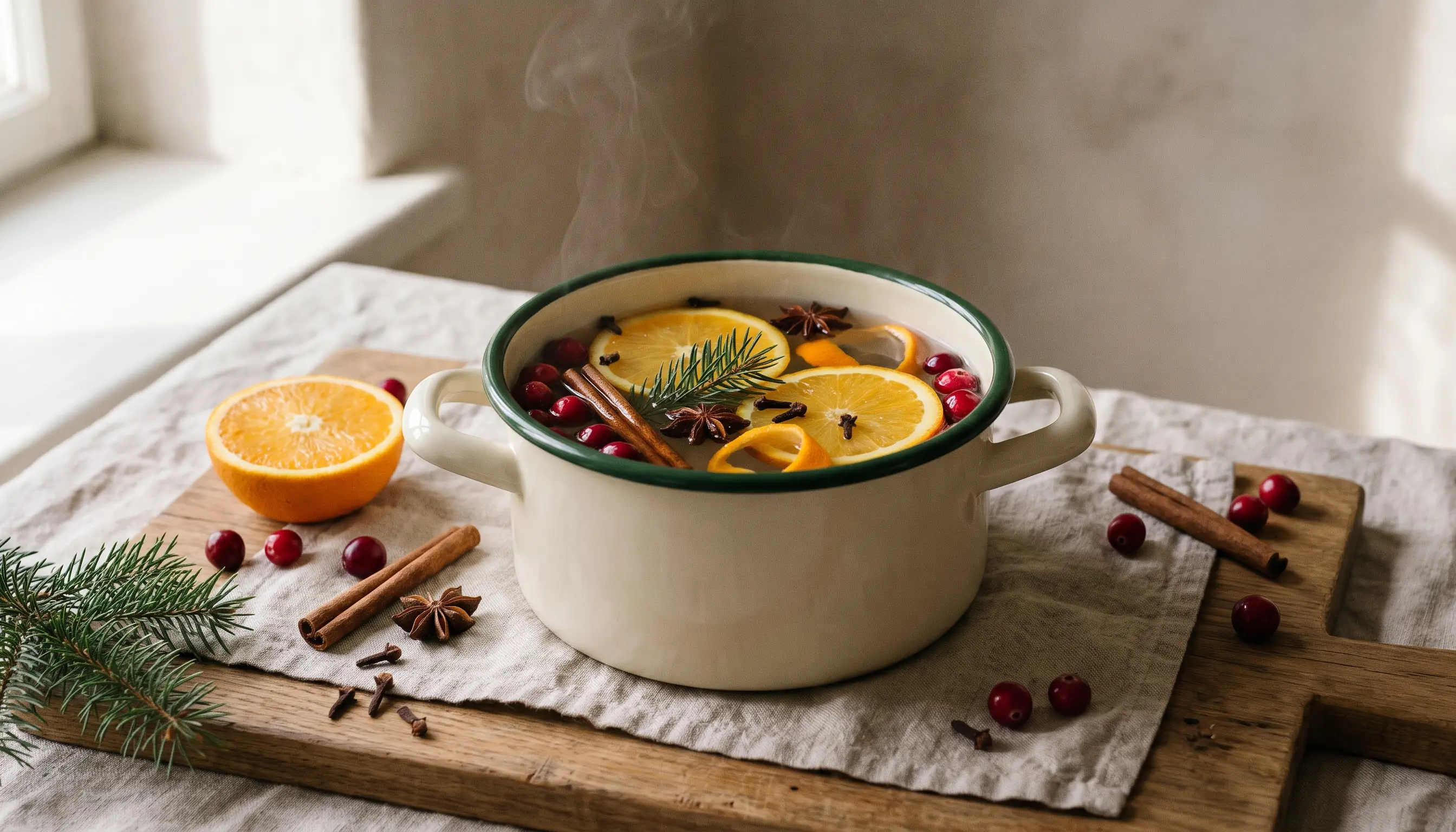
Orange peel, cranberries, cinnamon and cloves on the back of the stove: it's simmer-pot season. Should you add essential oils to the water?
We'd leave them out, which may surprise you coming from an essential-oil app. Below: why, a Christmas pot that doesn't need them, how to supervise it, how to keep pets away from it, and a stove-free alternative.
Can you put essential oils in a simmer pot?
You can, but we'd leave them out:
- You don't need them. Orange peel and whole spices already scent the pot.
- Oil and water don't mix. Essential oils don't dissolve in water; they float on top.
- They're flammable. The Tisserand Institute says essential oils shouldn't be used anywhere near "a naked flame or similar fire hazard". (Tisserand Institute) An open bottle doesn't belong beside a lit burner.
- Cats. Pet Poison Helpline warns that scented oils heated in a simmer pot can seriously harm cats (see "Simmer pots and cats" below).
Whatever goes in, a simmer pot perfumes a room rather than cleaning it. As The Coolist puts it, quoted by SheKnows: "A simmer pot perfumes the air; it doesn't clean it." (SheKnows)
A Christmas simmer pot, no oils needed
A simmer pot, also called stovetop potpourri, is a citrus, a whole spice or two and a fresh herb in water, kept on the lowest heat. Our Christmas version:
- the peel of 1 orange, or 2 clementines
- a handful of fresh cranberries
- 2 or 3 cinnamon sticks
- 1 teaspoon of whole cloves
- a sprig of fresh rosemary
Put everything in a medium saucepan with about 1 litre (4 cups) of water. Bring it to a gentle simmer, turn it down to the lowest heat, and top it up with hot water as it reduces.
To change the mood, swap the ingredients:
- Orange & Clove, the spiced one: orange peel, whole cloves and cinnamon sticks.
- Cranberry & Rosemary, the green one: cranberries, rosemary and an orange slice.
- Orange & Star Anise, the sweet one: orange slices, star anise and a cinnamon stick.
It may smell like mulled cider, but it isn't a drink. Use a pot you don't make drinks in, and never taste it.
How to supervise your simmer pot
A simmer pot is cooking, even if nobody eats it. The National Fire Protection Association (NFPA) says to check anything simmering regularly, remain in the kitchen while it cooks and use a timer as a reminder. (NFPA, cooking safety)
- Stay with it. Switch it off when you leave the room or go to bed.
- Never let it boil dry. Check it often and top it up with hot water.
- Use a back burner and turn the handles in, towards the back of the stove. (NFPA, PDF; City of Toronto)
- Keep children and pets clear. NFPA advises keeping children at least 1 m (3 ft) from the stove, and pets off nearby counters.
Hosting? In the US, NFPA says Thanksgiving is the peak day for home cooking fires, followed by Christmas Day and Christmas Eve, with unattended cooking by far the leading factor. (NFPA) Keep the pot away from the food and drink table, and tell guests it isn't cider.
Simmer pots and cats
Pet Poison Helpline's winter holiday page, under "Liquid Potpourri", warns that scented oils heated in a simmer pot "can cause serious harm to your cat", and that even a few licks can result in "severe chemical burns in the mouth". (Pet Poison Helpline)
That warning is about liquid potpourri and scented oils, not a pot of peel and spices. But leaving the oil out doesn't make a pot harmless to pets:
- the water is hot;
- the ASPCA lists orange as toxic to cats, noting that its skins and plant material "can cause problems" (ASPCA);
- VCA Canada says never to leave simmering potpourri unattended, as "curious animals may want to investigate the sweet-smelling liquids" (VCA Canada).
So keep the pot, its water and its ingredients where pets can't reach them, keep the cat off the counters while it's on, and give it a room without scent to retreat to. Never put essential oil on a pet: the ASPCA and our pets guide both advise against it. Ask your vet about your own animal.
If a pet licks or swallows anything from the pot, or any essential oil, call your vet or a pet poison line straight away: Pet Poison Helpline on (855) 764-7661, which serves the US and Canada, or, in the US, ASPCA Animal Poison Control on (888) 426-4435. Both run around the clock; Pet Poison Helpline charges a fee per incident, and the ASPCA says a consultation fee may apply.
Where else oil doesn't go this season
Essential oils are flammable, so keep them off:
- the furnace filter: an HVAC explainer calls it "generally not recommended", citing fire risk and a filter that clogs faster (Engineer Fix);
- light bulbs and string lights: NFPA's holiday safety messages say to keep decorations away from heat sources such as light bulbs (NFPA, PDF);
- logs, pine cones and fire starters, which would put a flammable liquid into the flame;
- the tree, including oiled cotton balls tucked into the branches.
Scent the room, not the tree.
The same scent without the stove
For the pot's smell without a burner, a diffuser can echo it. Here's an adult example, in parts rather than drops:
Orange Peel & Fir, for the diffuser (not for skin)
- 3 parts sweet orange
- 1 part fir needle
- 1 part cardamom
Orange for the peel, fir for the tree, cardamom for the spice jar.
💡 Check the Latin name on "fir needle" — Dilutio's fir needle is balsam fir (Abies balsamea), which the USDA Forest Service calls "one of the most popular Christmas trees". (USDA Forest Service, Silvics of North America, PDF via Virginia Tech) Bottles sold as "fir needle" may be Siberian fir (Abies sibirica) or balsam fir, depending on the brand, so check the botanical name: the results below are for balsam fir.
Why cardamom, not cinnamon or clove oil? In the pot, the sticks and buds do that job. As oils, both carry more flags in our library: cinnamon bark is marked expert-only and flagged as a skin sensitiser, and clove bud is marked not recommended in pregnancy or for young children. Our babies and children guide lists both among the "hot" oils to avoid for young children. If you do want a spice oil in the air, our autumn spice guide covers how to diffuse one carefully.
Turn parts into drops. In the Dilution Calculator, choose Diffuser and who it's for. It suggests a maximum drop count for a 300 ml (about 10 fl oz) diffuser; for a smaller tank, scale down (a 100 ml tank takes about a third). Keep your total at or under it, in roughly these proportions. Then check the blend in the Blend Analyzer, which opens set to Diffuser with "Cat at home" switched on. Both tools are free on the web, with no account. They check the recipe against their safety data, but as the analyzer notes, "Inhalation exposure and run time are not modelled", so neither can tell you a blend suits your room.
What the analyzer says about the blend as linked:
- With a cat at home: "Safety: resolve before use". Sweet orange and fir needle are both "Not recommended around cats." Don't swap oils to make it fit: a missing flag isn't evidence an oil suits cats. With a cat at home, skip this blend.
- Without a cat, for an adult: "Safety: read the cautions", with sweet orange and fir needle each "Flagged: oxidation risk." Use fresh bottles stored cool and dark: heat, light and moisture speed oxidation. (Tisserand Institute)
So it's an adult example, not a family blend. In pregnancy, ask your midwife or doctor first: our pregnancy guide notes that many practitioners suggest avoiding essential oils altogether in the first trimester. Ask your doctor or pharmacist before diffusing around a child.
When you diffuse, keep sessions short; the Tisserand Institute suggests diffusing intermittently, not all day. (Tisserand Institute) Use a ventilated room that people and pets can leave, and switch it off if anyone's eyes or airways feel irritated, taking extra care around anyone with asthma or another breathing condition. The Merck Veterinary Manual advises keeping pets out while it runs and airing the room afterwards. (Merck Veterinary Manual) If you keep birds, or a pet has a history of breathing problems, the ASPCA suggests skipping a diffuser altogether. (ASPCA)
Keep oil bottles out of children's reach. If anyone swallows essential oil, call a poison centre: 1-800-222-1222 in the US (Poison Control), 1-844 POISON-X (1-844-764-7669) in Canada, or 1-800-463-5060 in Quebec. (Health Canada)
Simmer pot, diffuser or candle?
| Simmer pot | Diffuser | Candle | |
|---|---|---|---|
| Heat or flame | A hot burner and hot water | No flame (ultrasonic and nebulising types) | An open flame |
| Attention needed | Never unattended; off when you leave the room | Short sessions, then off | Never unattended; out before you leave the room or go to bed |
| Children and pets | Back burner, handles in, out of reach | Out of reach, where it can't be knocked over | Out of reach |
| Cats specifically | No oils; pot, water and ingredients out of reach | Not this blend; any other only where the cat can't go, and ask your vet | Out of reach; never left burning in an empty room |
| Cleans the air? | No, it perfumes it | No, it perfumes it | No, it perfumes it |
The candle column follows NFPA's safety messages (PDF).
A simmer-pot gift jar
For a gift that leaves the oil out, fill a jar with dried orange slices, cinnamon sticks, whole cloves, star anise and dried rosemary. Skip anything that looks like a drink mix, such as sugar or cocoa layers. Tie on a tag:
For simmering only — not for eating or drinking. Add water and keep on the lowest heat. Never leave it unattended or let it boil dry. Keep away from children and pets.
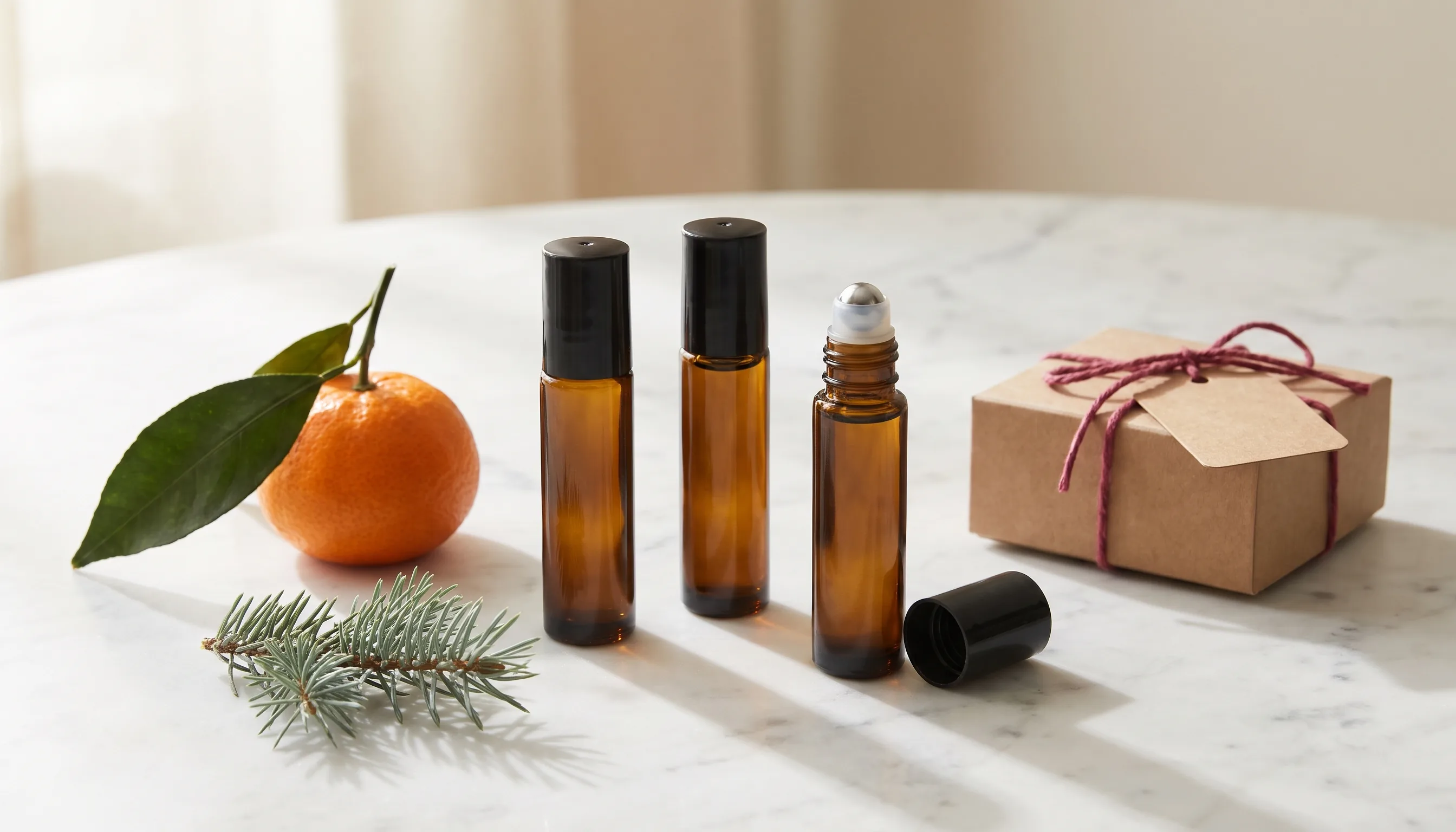
For a gift worn on the skin instead, see our Christmas roller blends guide.
If you'd rather make a stove-free blend of your own, the Dilutio app can build an AI blend idea from what you want it for, and Lutio in Smart Lab can suggest changes to oils you've picked. The free plan includes one AI blend a day with a free account. Treat any AI blend idea as a starting point, and check it in the Blend Analyzer for everyone who'll share the room, cats included.
The short version
- We'd leave essential oils out of a simmer pot: peel and whole spices already scent it, oil doesn't mix with water, and essential oils are flammable.
- The Christmas pot is orange peel, cranberries, cinnamon, cloves and rosemary in water on the lowest heat, and it isn't a drink.
- Stay with it, never let it boil dry, use a back burner with the handles turned in, and switch it off when you leave the room.
- Leaving the oil out doesn't make the pot harmless to pets, so keep it and its contents out of reach. If a pet licks or swallows any, call your vet, Pet Poison Helpline (855) 764-7661 or ASPCA Poison Control (888) 426-4435.
- Orange Peel & Fir is an adult diffuser example in parts: not for skin, and not for a home with a cat.
Safety note: This article is for general interest and is not medical or veterinary advice. Never swallow essential oils, and keep them away from flame and heat. Keep simmer pots, diffusers and oil bottles away from children and pets, especially cats, and ask a clinician or vet about any health concern.
For education only — not medical or veterinary advice. Essential oils are not intended to diagnose, treat, cure, or prevent any condition. Always patch-test and consult a qualified professional before use during pregnancy, on children, with pets, or with a health condition.