Christmas Roller Blends: DIY Gifts at the Right Strength
Many Christmas roller blends online are stronger than they need to be. Two adult gift rollers at 1% and 2%, a check for who's opening it, and a label to copy.
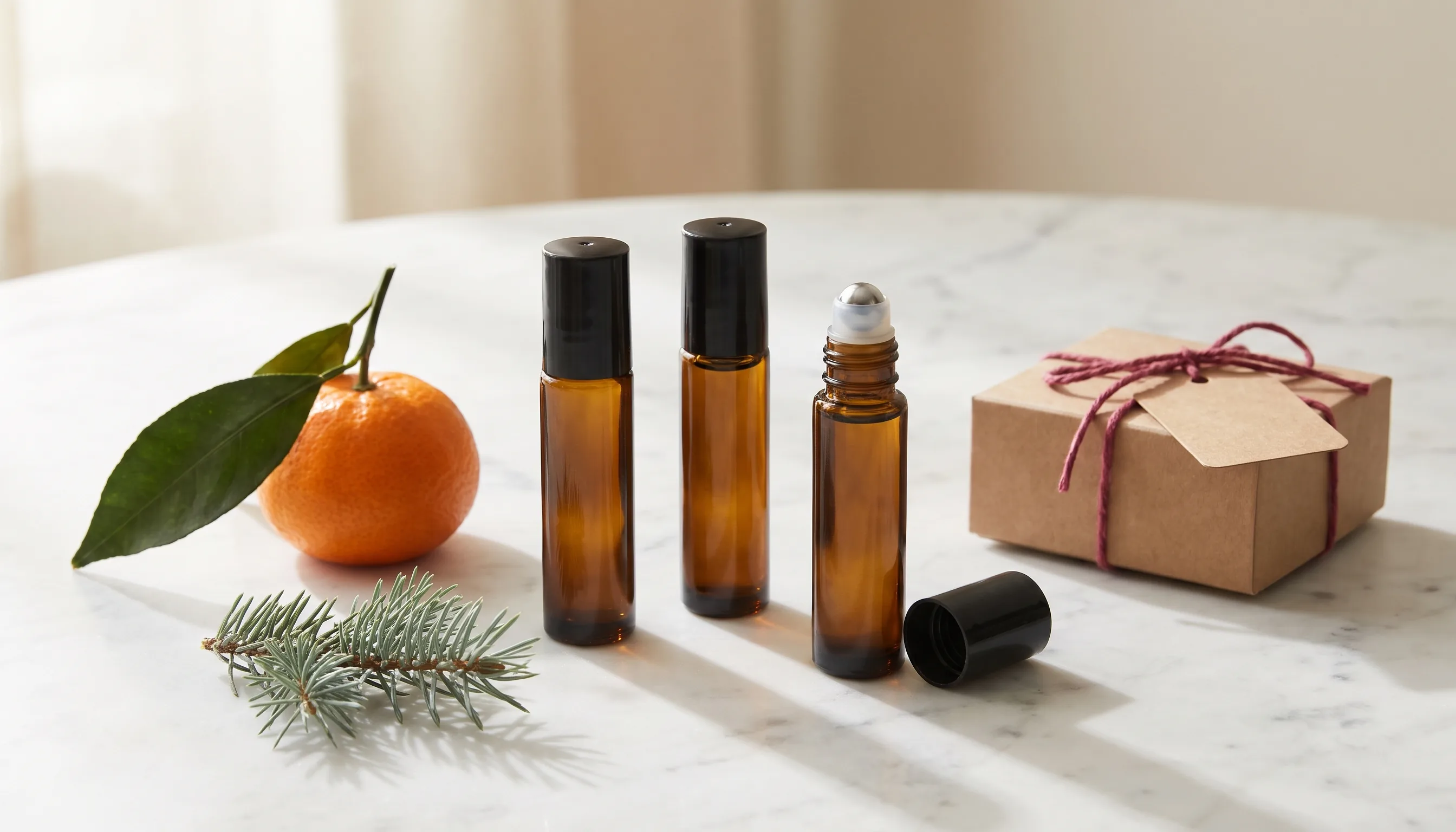
Pinterest says searches for "useful DIY gifts" are up 1,370% so far this holiday season (Social Media Today, 12 November), and Deloitte projects that Canadian spending on gifts and gift cards will drop 5% this year (Deloitte Canada). The classic answer to both is a Christmas roller blend: a homemade 10 ml (⅓ fl oz) roller of scented oil — cheap, useful and personal, if it's made at the right strength. Some of the most visible recipes aren't.
This guide covers two strengths, two recipes, one label, and the citrus that can't go in. It's for adults, with linked Blend Analyzer results for each likely recipient.
Why so many Christmas roller blends online are too strong
Among the pages that rank for "Christmas roller blends" and for DIY essential oil gifts, we found four patterns:
- Rollers for the chest, shoulders and wrists at twice the strength our calculator uses for general adult body use.
- Rollers labelled "2%" that hold an extra drop.
- Bergamot not marked FCF (FCF bergamot has its sun-reactive compounds removed) in a leave-on roller, with no word about sun.
- A grapefruit and bergamot roll-on called suitable for younger children, breastfeeding and pregnancy, on one popular DIY-gift page.
"A few drops" isn't a strength:
- Drops are the total for all the oils together. Four drops of each is a stronger recipe than four drops in total.
- A drop is an estimate. Our Dilution Calculator assumes about 20 drops per millilitre, and "Conversion rates that use drops are always approximate" (Tisserand Institute).
- The bottle sets the percentage: drops = % × ml ÷ 5, so in a 10 ml roller 1% is 2 drops and 2% is 4 drops.
How many drops go in a 10 ml roller? The two-and-four rule
In an adult's 10 ml roller, 2 drops of essential oil in total make 1% and 4 drops in total make 2%. Use 1% for anything worn every day and 2% for occasional body use.
| Strength | Drops of essential oil, in total | What the calculator uses it for |
|---|---|---|
| 1% (gentle) | 2 | Face, sensitive skin, daily use, older adults |
| 2% (balanced) | 4 | General adult body use |
A gift roller gets carried and reached for often, so 1% is the default gift strength (full table), and the 2% recipe below is labelled for occasional use. These numbers are for adults only; pregnancy, children and pets come next.
First, who's opening it?
- An older relative: give the 1% roller. The analyzer gives the 2% one "Safety: resolve before use" for older adults (see below).
- Someone pregnant: neither roller. Don't try to make one fit by adapting it or lowering the drop count: our pregnancy page notes that "Many practitioners suggest avoiding essential oils altogether in the first trimester", so leave that call to their midwife or doctor (why pregnancy "avoid" lists disagree).
- A child: neither roller is a children's gift. See babies and children, ask the child's doctor or a pharmacist, and keep oils "in a place where young children cannot reach them" (Tisserand Institute).
- A home with a cat: neither roller. Both get "Safety: resolve before use" in the analyzer with "Cat at home" switched on (see below). Never put oil on a pet; see the pets page and ask a vet.
- Someone breastfeeding: neither roller from this post; ask a midwife, doctor or pharmacist.
- A nut allergy: pick the carrier with care and name it on the label.
- Sensitive skin: suggest a patch test first (the AAD's test-spot method) and stop if the skin reacts. A skin allergy, once learned, generally lasts for life (Tisserand Institute).
The citrus trap, and what else stays out of a gift roller
Some citrus oils are phototoxic: on skin that then sees sun, they can cause a reaction that "often looks like a burn" (Tisserand Institute). Our phototoxic oils table gives these limits, the same whether or not the skin will see sun: bergamot (non-FCF) 0.4%, lime (cold pressed) 0.7%, bitter orange 1.25%, lemon (cold pressed) 2%, and pink or white grapefruit 4%.
Bergamot is the trap. Its 0.4% limit matches the IFRA guideline for leave-on products (Tisserand Institute), and in a 10 ml roller even one drop is over it. Pair one drop with one drop of sweet orange and the analyzer flags it for an adult: "Safety: resolve before use", with bergamot "above its published 0.4% dermal maximum". Switch to bergamot FCF, which is furanocoumarin-free and "considered to be non-phototoxic" (Tisserand Institute), and the same pair gets "Safety: read the cautions", with "no specific limit" for the bergamot. So if the bottle doesn't say FCF, treat it as non-FCF and leave it out; that's why this post has no bergamot recipe.
Winter sun counts. Bright snow can almost double the UV you get, and skiing in the mountains adds more (Environment and Climate Change Canada; WHO). For questions about sun and skin, ask a dermatologist or doctor.
Citrus without a sun limit. Clementine isn't phototoxic in our data, and cold-pressed mandarin, tangerine and sweet orange aren't considered phototoxic either (Tisserand Institute; Hana Tisserand). The analyzer still flags clementine, mandarin and sweet orange for oxidation, so buy fresh bottles.
Also out of a gift roller:
- Cinnamon bark and clove, among the oils "more likely to cause skin reactions than others" (Tisserand Institute); see our autumn spice guide.
- Wintergreen and sweet birch: mostly methyl salicylate, and Essential Oil Safety recommends against them for children of any age, in pregnancy, and with blood-thinning medication such as aspirin or warfarin (Tisserand Institute).
- Peppermint and eucalyptus in gifts for homes with young children. Our children's page says: "avoid for young children, especially near the face".
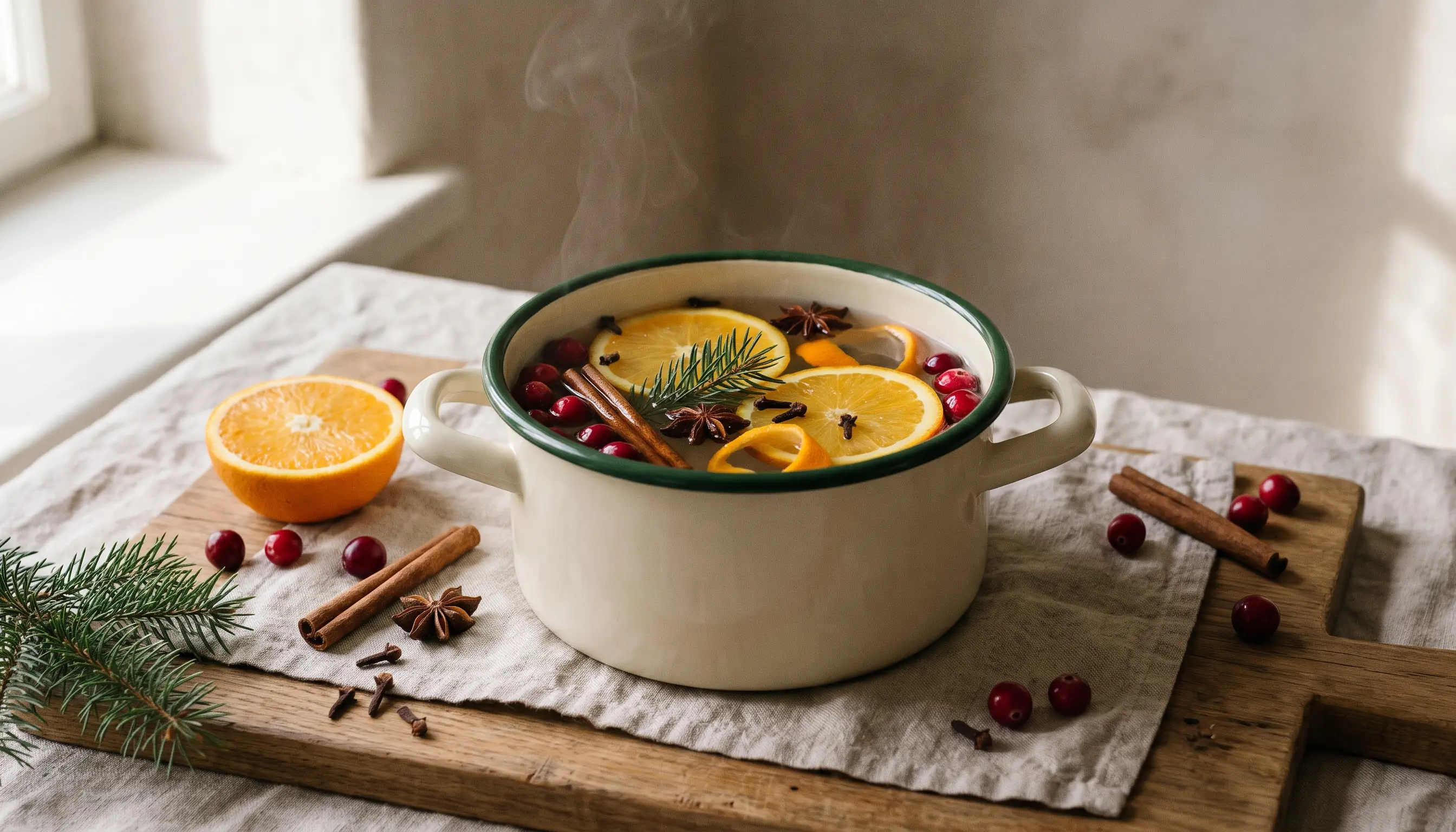
- Anything for the lips or mouth, and oil in anything edible (cocoa mix, tea, honey, sweets). For a kitchen gift with no oil at all, try a simmer-pot gift jar of dried orange and whole spices, for simmering, not for eating or drinking.
Silver Fir & Clementine: an everyday roller at 1% (adults)
Green and bright, like a fir sprig beside a peeled clementine: the everyday roller, and the one for an older relative.
- 10 ml jojoba (or fractionated coconut oil)
- 1 drop silver fir (Abies alba)
- 1 drop clementine (Citrus clementina)
- 2 drops of essential oil in total = 1%
Check it for the person you're giving it to:
- Adult (check): "Safety: read the cautions" — "2 drops in 10 ml · 1% dilution of a 3% ceiling" (a ceiling is a maximum, not a target). Both oils are "Flagged: oxidation risk."
- Older adult (check): "Safety: read the cautions" — "Total dilution is 1%, close to the 1% ceiling for elderly."
- Pregnant (check): "Safety: read the cautions" — "Total dilution is 1%, close to the 1% ceiling for pregnant."
- Child (2–6) (check): "Safety: read the cautions", with an age note on each oil: "check the child's actual age." Not a children's recipe.
- Cat at home (check): "Safety: resolve before use". Both oils are "Not recommended around cats." VCA Animal Hospitals lists citrus among oils poisonous to cats, through the skin as well as by mouth (VCA).
A caution is not a clearance. Ingredient-level flags don't make a finished recipe suitable for everyone. This is the roller for an older relative because 1% is the ceiling the analyzer uses for older adults; the pregnancy and child results are no reason to give it to either.
Check the Latin name. Silver fir is Abies alba (EUFORGEN). "Fir needle" is a trade name: one US seller lists the botanical name as Abies sibirica, Siberian fir (listing); another lists Abies balsamea, balsam fir (listing), as does our fir needle entry. Neither listing gives silver fir as its botanical name, so for this recipe, look for Abies alba on the bottle.
Fresh bottles, dated. Both oils carry the analyzer's oxidation flag, and oxidised oils "can also present a higher risk of adverse reaction" (Tisserand Institute). Buy small bottles, date them when opened, keep them capped, cool and dark (how oils oxidise), and date the roller.
Fireside Woods: a body roller at 2% (adults, occasional wear)
Warmer and drier — cedar shavings, a thread of resin, a little peel — for occasional adult body use, not everyday wear.
- 10 ml jojoba
- 2 drops Virginia cedarwood (Juniperus virginiana)
- 1 drop frankincense (Boswellia carterii)
- 1 drop mandarin (Citrus reticulata)
- 4 drops of essential oil in total = 2%
Check it for the person you're giving it to:
- Adult (check): "Safety: read the cautions" — "4 drops in 10 ml · 2% dilution of a 3% ceiling". Frankincense and mandarin are "Flagged: oxidation risk."
- Older adult (check): "Safety: resolve before use" — "Total dilution is 2% — above the 1% maximum for elderly on the body." Give them Silver Fir & Clementine instead.
- Pregnant (check): "Safety: resolve before use": "Total dilution is 2% — above the 1% maximum for pregnant on the body", and Virginia cedarwood is "Not recommended during pregnancy." Even one drop of cedarwood with one of mandarin still shows "Safety: resolve before use", so don't adapt it.
- Child (2–6) (check): "Safety: read the cautions" — "Total dilution is 2%, close to the 2% ceiling for child (2–6)." Not a children's recipe.
- Cat at home (check): "Safety: resolve before use". Mandarin is "Not recommended around cats."
The analyzer may suggest a swap. For a home with a cat, don't: a missing flag isn't evidence an oil suits cats, and our pets page says "when unsure, keep oils away from them entirely."
Why Virginia cedarwood, not Atlas? Atlas cedar (Cedrus atlantica) is listed as Endangered on the IUCN Red List (Royal Botanic Garden Edinburgh). Virginia cedarwood comes from eastern redcedar, Juniperus virginiana, "a juniper and not a true cedar" (Virginia Cooperative Extension), so check for that Latin name.
Make it a set, and label it
Gift the recipe, not just the bottle: the label tells the recipient what's on their skin and lets them make it again.
One skin product per set. For contact allergy, what counts is "the cumulative dose per unit area", whatever the source (European Commission). Two rollers put more on the same skin.
Add a diffuser card instead. For newcomers to fragrance layering, one perfume product developer suggests a "bridge note" that two fragrances share (Forbes, via Yahoo). For the Silver Fir & Clementine set, the bridge is fir, in the air:
Fir & Clementine, for the diffuser
2 parts silver fir to 1 part clementine.
Get the drop count for your diffuser and household at dilut.io/dilution-calculator.
Short sessions in a ventilated room that people and pets can leave; ask a doctor or pharmacist before diffusing around a child. Not for homes with a cat, birds or a pet with breathing problems.
The ASPCA suggests avoiding diffusers around birds and pets with a history of breathing problems.
The label. Copy this onto a tag:
Silver Fir & Clementine
Silver fir (Abies alba) and clementine (Citrus clementina) in jojoba oil
1% — 2 drops of essential oil in total in 10 ml jojoba, for everyday adult wear
Made on: [date]
For adults. External use only. Patch test first; stop if skin reacts. Keep away from children and pets. Store cool and capped.
Recipe: dilut.io
Used fractionated coconut oil instead? Write that in place of jojoba.
For Fireside Woods, list its oils with Latin names and use: 2% — 4 drops of essential oil in total in 10 ml jojoba. Adult body, occasional use; for everyday wear, use a 1% blend.
Name the carrier. Almonds are a tree nut, and coconut isn't on the official tree-nut allergen lists in the US (FARE) or Canada, yet Health Canada notes that "some people allergic to tree nuts have also reacted to coconut and nutmeg" (Health Canada). So ask about nut allergies first, skip sweet almond and coconut oil for anyone who has one, and name the carrier on the label; our carrier oil guide compares the options.
Keep these words off the label: "sleep", "focus", "energy", "immune", "pure", "therapeutic-grade", "non-toxic", "chemical-free". The first four read as promises about body or mind, the rest as claims the recipient can't check.
Check it before you wrap it
In the Blend Analyzer, choose the 10 ml roller, pick who it's for — Adult, Pregnant, Elderly or Child (2–6) — and switch on "Cat at home" if they live with a cat; the strength table is on the roller bottle calculator. Both are free and need no account.
Prefer to start from an idea? In the Dilutio app for iPhone and Android, you can get an AI blend idea from what you want it for, or let Lutio in Smart Lab suggest changes to oils you've picked; the free plan includes one AI blend a day with a free account. Treat any AI blend idea as a starting point, and check it for the recipient like any other recipe.
If something goes wrong
If skin reacts, stop, don't add more oil, and wash gently with soap and water (Poison Control; Tisserand Institute); a reaction with difficulty breathing is a medical emergency: call 911 or your local emergency number. If oil is swallowed, call a poison centre: 1-800-222-1222 in the US (Poison Control), 1-844 POISON-X (1-844-764-7669) in Canada, or 1-800-463-5060 in Quebec (Health Canada). For a pet, call your vet or the Pet Poison Helpline on (855) 764-7661, which runs 24/7 across the US and Canada (a fee applies); in the US, the ASPCA Animal Poison Control Center is on (888) 426-4435 (a consultation fee may apply).
The short version
- For an adult's 10 ml roller: 2 drops of essential oil in total = 1%, for everyday wear; 4 drops in total = 2%, for occasional body use. Gifts default to 1%.
- Ask who's opening it. An older relative gets the 1% roller; pregnancy, children, breastfeeding and homes with cats get no roller from this post.
- One drop of non-FCF bergamot in a 10 ml roller is over its 0.4% limit. No "FCF" on the bottle? Treat it as non-FCF.
- Leave out cinnamon bark, clove, wintergreen and sweet birch; no peppermint or eucalyptus where young children live; nothing near lips or food.
- Use fresh bottles, check Latin names, name the carrier, date the label, keep to one skin product per set, and check every recipe in the free Blend Analyzer.
Safety note: This article is for general interest and is not medical or veterinary advice. These recipes are for adults and for external use only: never ingest essential oils, dilute before skin use, and patch test first. Some citrus oils are sun-sensitive; see our phototoxic oils table. For pregnancy, children and pets, see the pregnancy, babies and children and pets pages, keep oils away from pets (especially cats), and consult a qualified clinician or vet. Further reading: Tisserand Institute safety guidelines.
For education only — not medical or veterinary advice. Essential oils are not intended to diagnose, treat, cure, or prevent any condition. Always patch-test and consult a qualified professional before use during pregnancy, on children, with pets, or with a health condition.